
What is Scaling?
It is the process of expanding the existing computers/server's capacity to handle a large number of requests.
This can be done by improving each system's capacity by adding more processing power or RAM (Vertical Scaling). Or by using multiple systems to handle the requests (Horizontal Scaling).
Each method has its advantages and disadvantages. So let's discuss these two methods in detail
Comparing Horizontal and Vertical Scaling
| Vertical Scaling | Horizontal Scaling |
|---|---|
 | 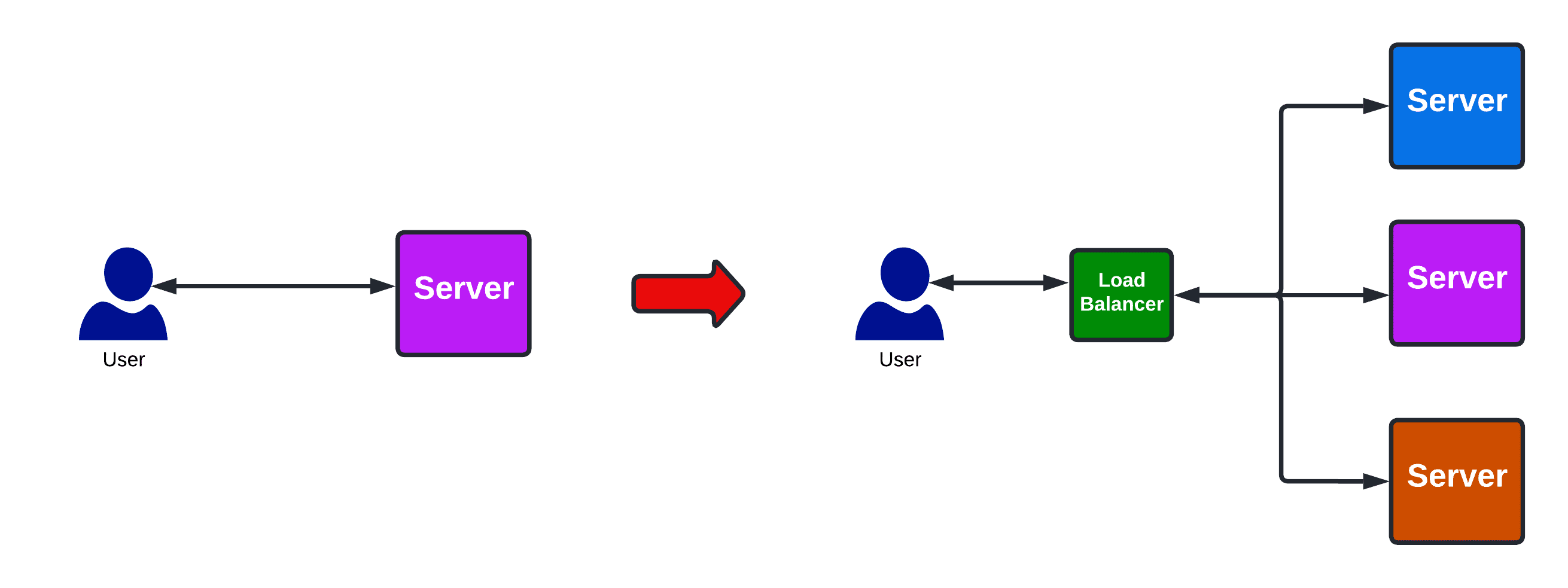 |
| In this method we improve the capacity of existing machine to improve performance | It this method we add more machines to improve performance |
| Since we have a single machine,we don't need a load balancer | We need to balance all requests between all the machines, so we need a load balancer |
| There is only one machine. If it fails our entire system goes down. So it is a Single Point of Failure | If one machine fails we can redirect the requests to other machines so there is no Single Point of Failure. It is Resilient |
| Here we have Inter-Process Communication which is faster | Communication between the servers will happen over the network. So the communication is Slow |
| There is only one system where data resides so data is always consistent. | If we want a transaction to be atomic we have to lock all other servers, which is impractical. So we have losse transactional guarantee. Therefore Data Consistency can be an issue |
| It is easier to implement and maintain since there is only one system | It is difficult to implement and maintain. |
| There is an hardware limitation. i.e., we can increase the system's capacity upto a certain extent | There is no hardware limitation. We can keep adding servers depending upon the use case |
That's it for now!
You can check out more designs on our video course at InterviewReady.
