
Requirements
Prioritized requirements
- System should store all the relevant profile data like name, age, location, and profile images.
- Users should be recommended matches based on their previous choices.
- System should store the details when a match occurs.
- System should allow for direct messaging between two users if they have matches.
Requirements not a part of our design
- Allowing moderators to remove the profile.
- Payment and subscriptions for extra features.
- Allowing an only limited number of swipes to users without a subscription
Estimation
- We will store 5 profile images perusers.
- We are assuming the number of active users is 10 million.
- We are assuming the number of matches is 0.1% of total active users i.e., 1000 matches daily.
Requirement 1: Profile creation, authentication, and storage
Description
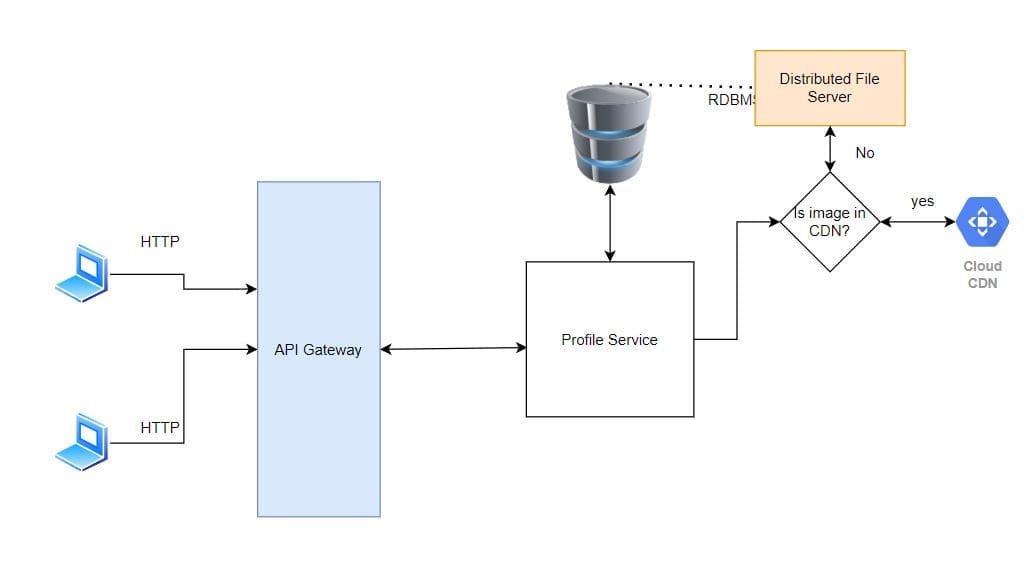
First, the system should allow a new user to create an account and once the account has been created then it needs to provide the user with an authentication token. This token will be used by the API gateway to validate the user.
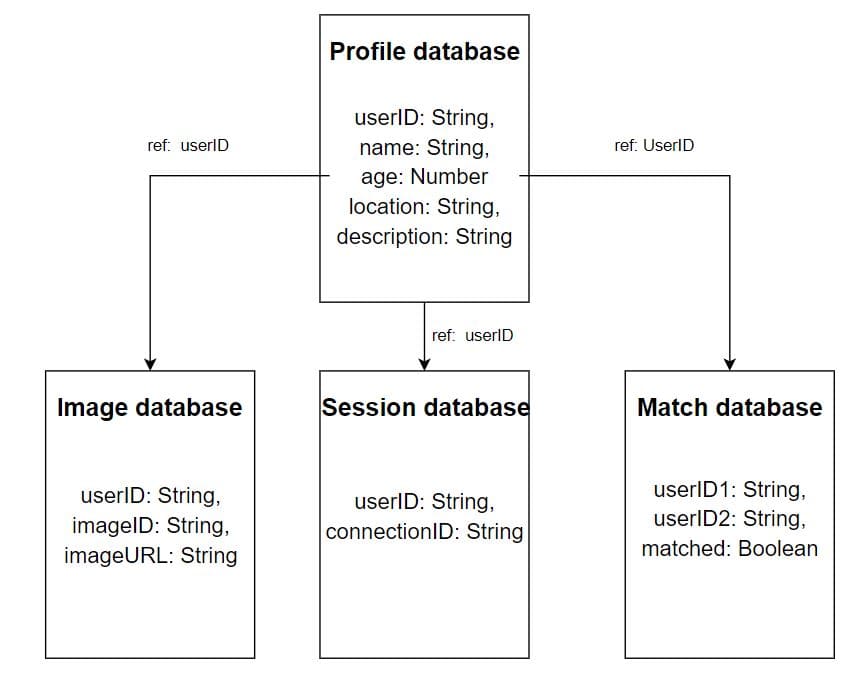
The system needs to store the profile name, age, location, and description in a relational database. However, there are 2 ways to store images.
- We can store images as a file in File systems.
- We can store images as BLOB in databases.
Components required
-
API Gateway Service
- It will balance load across all the instances.
- It will interact with all the services
- It will also validate the authentication token of the users
- It will redirect users to the required service as per their request.
-
Distributed File System to store images
- We will use CDN to serve the static images faster.
-
Relational database to store user information
- We will store the user ID, name, age, location, gender, description, (user preferences), etc.
Trade-offs
-
Storing images as File v/s Storing images as BLOB
-
Features provided by the database when storing images as BLOB
-
Mutability: When we store an image as a BLOB in the database we can change its value. However, this is useless as because an update on the image is not going to be a few bits. We can simply create a new image file.
-
Transaction guarantee: We are not going to do an atomic operation on the image. So this feature is useless.
-
Indexes: We are not going to search the image by its content (which is just 0's and 1's) so, this is useless.
-
Access control: Storing images as BLOBs in the database provides us access control, but we can achieve the same mechanisms using the file system.
-
-
Features provided by the file system when storing images as files
-
They are comparatively cheap.
-
They are comparatively faster because they store large files separately.
-
Files are static, so we can use CDN for faster access.
-
So for storing user images we will use Distributed File System
-
Diagram
Requirement 2: One to one Chat messaging
Description
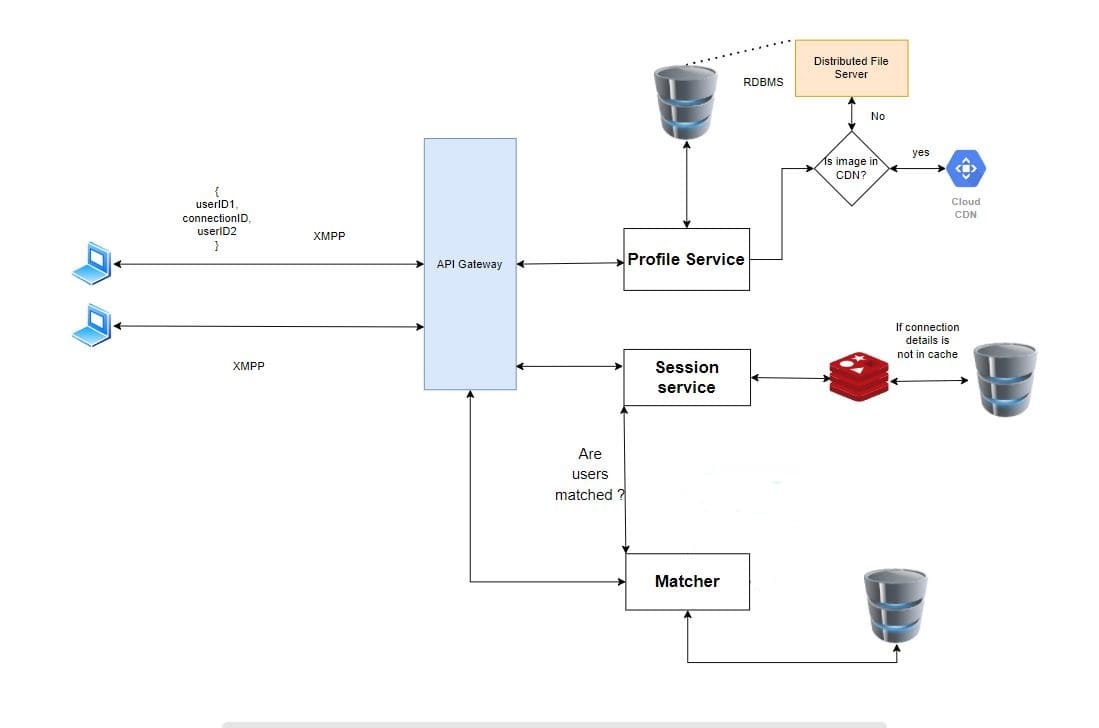
The system should allow one-to-one chat messaging between two users if and only if they have matched. So we have to connect one client to another.
To achieve this we use the XMPP protocol that allows peer-to-peer communication.
Components required
-
Relational database
- We will use this database to store the user ID and connection ID
-
Cache
- We do not want to access the database every time a client sends a message, so we can use a cache to store the user ID and connection ID.
Trade-offs
- Use of HTTP for chat v/s Use of XMPP for one to one messaging
- When we use HTTP XMPP we can only message from client to server. The only way we can allow messaging is by constantly sending a request to the server to check if there is any new message (polling).
- XMPP is a peer-to-peer protocol that allows clients and servers to send messages to each other.
- As we do not need to constantly send requests to sever, using XMPP will be more efficient.
Diagram

Requirement 3: Matching right-swiped user
Description
The server should store the following information
- Users who have matched (both have right-swiped each other)
- One or both of the users have left swiped each other.
This service would also allow the chat service to check if the users are matched and then allow one-to-one chat messaging.
Components required
-
Relational database
- We will use this database to store the user IDs of both the user
- We will use indexes on the user ID to make queries faster.
Trade-offs
-
Storing match details on the client v/s Storing match details on the server
- One benefit of storing the match details on the client we save storage on the server-side. However, as we are storing only the user IDs it is not significant.
- If we store match data on the client-side then all data is lost when the user uninstalls the applications but if we store it on the server then the data is not lost.
- Benefit of storing the details on the server-side is that it becomes a source of truth. And as the details on the server cannot tamper so, it is more secure.
- So we store the relevant details on the server-side
Diagram
Requirement 4: Server recommendations to users
Description
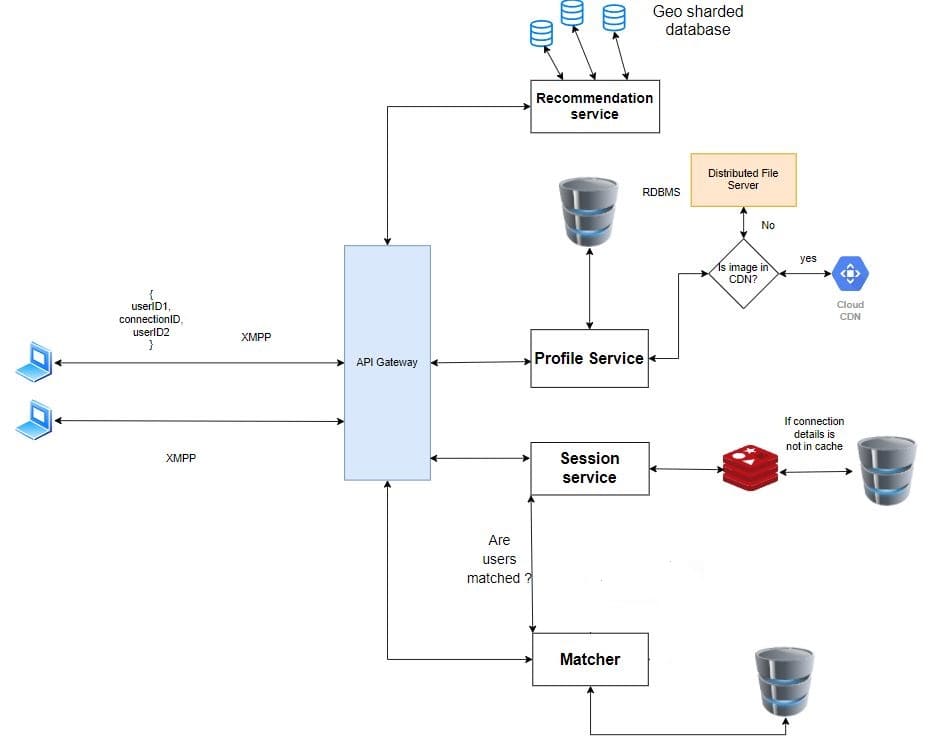
The server should be able to recommend profiles to users. These recommendations should take into consideration age and gender preferences. The server should also be able to recommend profiles that are geographically close to the user.
Components required
- Relational database
- We can do horizontal partitioning (sharding) on the database based on the location. Also, we can put indexes on the name and age, so we can do efficient query processing.
- For every database partition we will have a master-slave architecture. This will allow the application to work even if the primary database fails.
Diagram
Database design
API Design
Profile service
- POST /user/signup - Creates new account
- GET /user/login - Sends the user authentication token
- GET /user/:userID - Gets the profile of the user ID
- PUT /user/:userID - Update user details
- DELETE /user/:userID - Removes the user account
Session service
- GET /session/users/:connectionID - Returns both the users that have the connection ID.
- DELETE /session/connection/:connectionID - Deletes all the data that have the connection ID.
- POST /session/connection/:userID1/:userID2 - Adds user ID1 and user ID2 with the same connection ID.
Matcher service
- GET /match - Return all the matches of the logged-in user.
- DELETE /match/:userID - Deletes the user ID from the match list.
Recommendation service
- GET /recommendation - Returns a collection of most appropriate profiles for logged-in user.
That's it for now!
You can check out more designs at InterviewReady.
References:
Tinder Gateway: https://medium.com/tinder/how-we-built-the-tinder-api-gateway-831c6ca5ceca
YouTube: https://www.youtube.com/watch?v=tndzLznxq40
