
Prioritized requirements
- Allow users to call each other over VoIP or PSTN
- Route call from one user to another and allow government bodies to record suspicious call
- Charge users for making calls.
- Choose a provider for each call.
Requirements not a part of our list
- Authentication service
- Allow users to send messages
Capacity Estimation
1. The bandwidth required to handle calls.
-
Assumption Number of users = 10 million Number of users making call every day = 25% Average length of each call = 1 minute Bandwidth for each PSTN call = 64kbps Bandwidth for each VoIP call = 100kbps
-
Number of calls per day = 2.5 million calls
-
Number of minutes for all calls = 2.5 million minutes
-
Number of minutes in a day = 24*60 = 1440
-
Number of calls at any moment = (Total talk time)/(Number of minutes in a day) = 1736 calls ~ 2000 calls
-
Minimum bandwidth for PSTN calls = Number of calls at any moment * Bandwidth of each PSTN call = 128 Mbps
-
For peak hours, bandwidth will be = 128*3 ~ 400Mbps
-
Minimum bandwidth for VoIP calls = Number of calls at any point * Bandwidth of each VoIP call = 200 Mbps
-
To reduce network congestion during peak hours, the required bandwidth will be = 200*4 ~ 800Mbps
Despite VoIP having twice the requirement of the PSTN bandwidth, the VoIP lines are cheaper
2.Total storage required to record calls
-
Assumption Number of users = 10 million Number of users making call every day = 25% Average length of each call = 1 minute Percentage of suspicious calls = 0.01% Number of copies for fault tolerance = 3 Life of each recording = 10 years Size of 1 minute of audio file = 10 MB
-
Number of calls to be recorded = 0.0001 * 0.25 * 10,000,000 = 250 calls
-
Total storage required = 2.5Gb * 3 * 365 * 10 ~ 30 TB
Total cache storage required for caching call states
-
Assumption Number of fields per call = 20 Length of each field = 20 characters Size of each character = 1 byte During crisis call volume can become 50 times the normal volume.
-
Number of characters for each call = 400 characters
-
Storage required for all calls = 2000 * 400 ~ 1 MB
-
Storage required during crisis = 50 * 1 MB = 50 MB (which is negligible)
Requirement 1: Allowing users to make a call over VoIP or PSTN
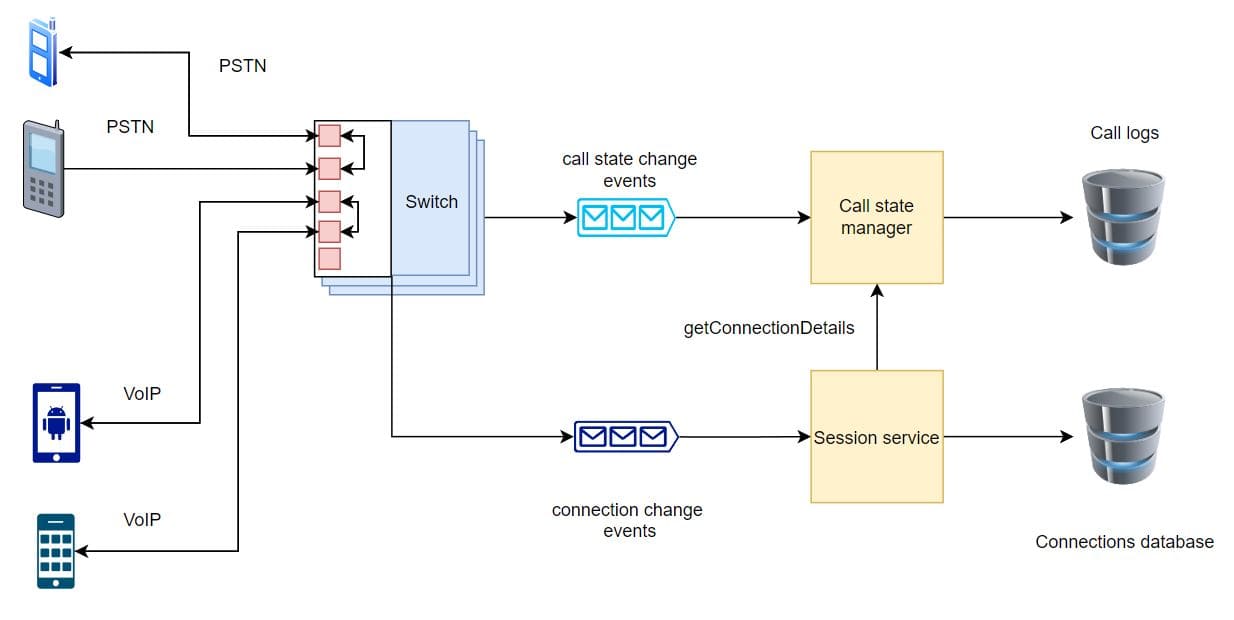
We have to implement a system that allows users to make calls over both VoIP and PSTN. We also want to separate the business logic from the components that connect the sender and receiver
Components required
-
Switch Whenever there is a call we get a receiver address and sender address. A switch bridges the connection between these two addresses.
-
Message queue
We need two message queues.
-
First, whenever there is a change in call state (like a user has picked up a call or a call is requested) we push it to the call state change queue. The call manager subscribes to this message queue and then processes the events one by one.
-
Secondly, whenever a connection is created or terminated we push it to Connection Event Queue.
-
-
Call state manager
This component is the brain of our system. It receives the call event from the switch. It receives the connection ID of both users from the session service and tells the switch which two connections it has to bridge. Apart from that it also checks what is the current state of the call. Like, such as whether the call is terminated or is ongoing. This data is then provided to the billing service.
-
Session service It pulls call events from the connection event queue. It stores the mapping of a user to call a session. And each session is mapped to a connection.
Comparison between VoIP and PSTN
| VoIP | PSTN |
|---|---|
| Only internet connections are required to make calls | Telephone lines are required to make calls |
| It requires variable bandwidth | It reserves fixed bandwidth |
| Cost is not dependent on distance and time | Cost is dependent on distance and time |
| It is generally free to use. | It is a paid service |
Diagram
Requirement 2: Routing call from one user to another and allowing government bodies to record suspicious calls
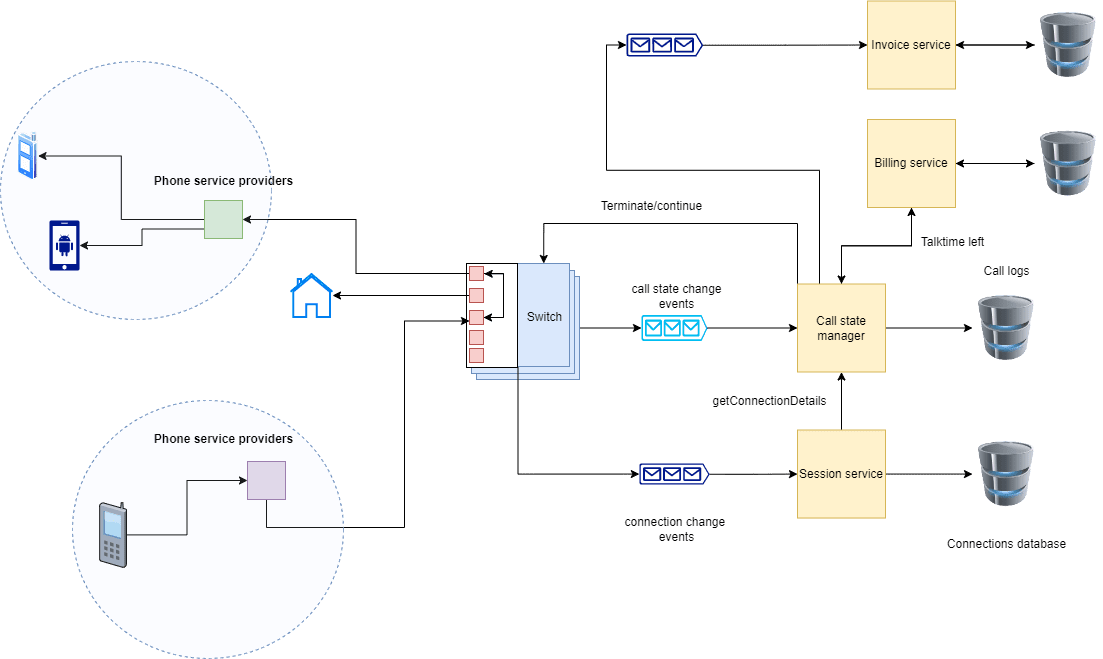
When making a call sender has the address of the receiver. We need to route calls from sender to receiver. To do that there are phone service providers. When users make a call routers forward the call to the next router and so on. This process is repeated until the receiver is found. Our server should allow only authenticated users to make calls and also route calls from sender to receiver.
To record suspicious calls our system should open a separate connection to them.
Diagrams

Requirement 3: Charging users for making calls
We need to implement a system that checks the current balance and the maximum talk time of the user. If users exceed their maximum talk time then the call should be terminated.
We also need to generate an invoice for calls made by a user.
Trade-offs
-
Persisting user data in switch v/s Persisting data in Call state manager
If we persist data on the switch we will require fewer API calls because if the user exceeds the time limit then the switch can directly terminate the call. However, the switch has to take up multiple roles.
If we persist data on the call state manager we will require more API calls. Switch first asks CSM whether to continue the call or terminate it and CSM asks the same question to the billing service.
It makes more sense to go with the second approach because CSM is the brain of our system and it makes sense to let it handle the billing and termination. Also, we put all data in switch then it has to take up multiple roles and we do not want that. The switch should only perform one task i.e. bridging and terminating calls.
Components required
-
Billing service
It keeps the current balance and talks time left of a user. It then sends the data to call the state manager.
-
Invoice service
Once the call is done we want to generate an invoice for that we need an invoice service. It gets all the data (like call duration and cost per minute) from the call state manager and makes an invoice.
-
Message queue
To generate an invoice we push call events to this message queue and the invoice service subscribes to this message queue.
We will push at least one event to this queue but each event will have a unique ID. If the key is already present in the invoice service that means we have already generated the invoice. We do this to ensure the user is charged only once per call
Diagram
Requirement 4: Choosing the right service provider for each call
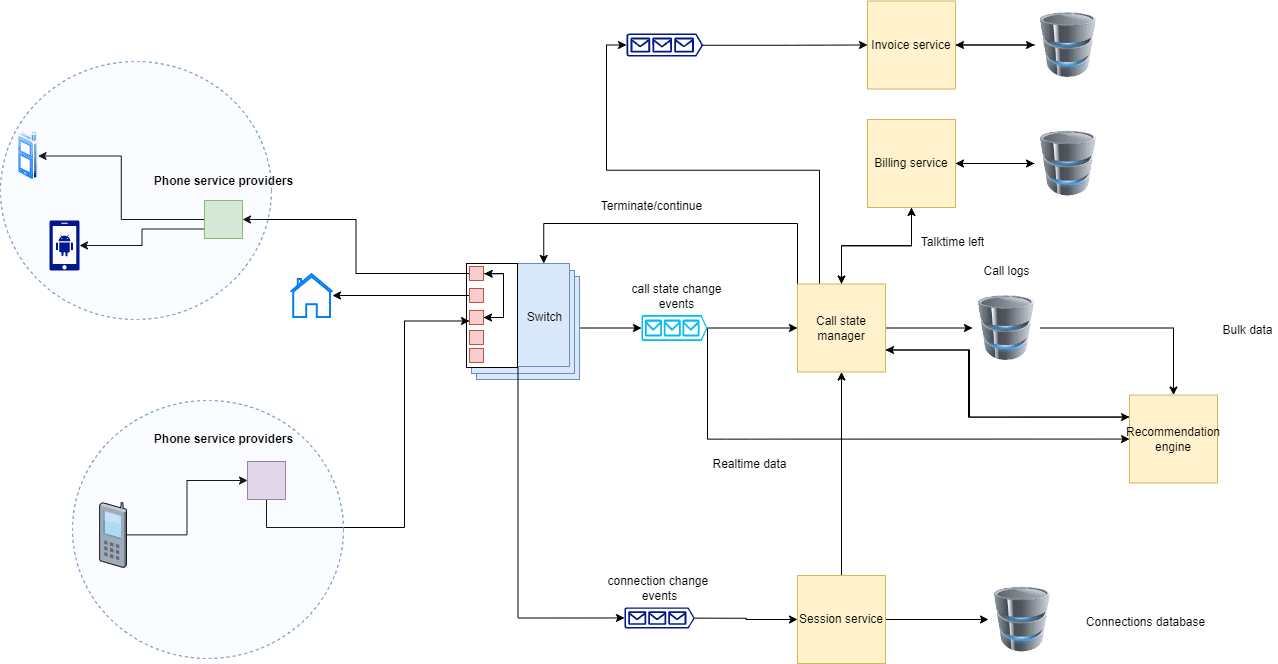
We need to consider two factors when choosing the right service provider. Call quality and service provider fee. Depending on what our needs are we need to choose the best service provider.
Components required
-
Recommendation service
It derives insights from the previous data and based on that finds a service provider with the best call quality and minimum fee. It gets bulk data from call logs. It also subscribes to the call state change queue to get real-time events (This architecture is called lambda architecture).
Diagram
API Contracts
Session Service
-
Session createSession(userID, connectionID)
-
Session[] getSessions(user_id)
-
void logoutSession(session_id)
Call State Manager
-
Call startCall(User from, User to)
-
Bool continueCall(call)
Switch
- Call startCall(callStateMachine)
Invoice service
- Invoice createInvoice(callID, talkTime, currency, pricePerMinute)
Billing service
- void addBalance(userID, amount)
- getBalance(userID)
Recommendation engine
- ServiceProvider getRoute(user sender, user receiver)
Database design

That's it for now!
You can check out more designs at InterviewReady.
