
In an audio search engine, users send a sound clip to us and we need to identify the sound clip is part of which song.
Let's start with a simple solution
Comparing waveforms
A song/sound clip is just a wave. For each song, we can save its waveform in our database. To make our search results more accurate we can store multiple waves of frequency v/s time, amplitude v/s time, etc. Whenever we get a new sound clip we compare the sound clip's waves with every song's waves. The song which matches the maximum with the clip's waves is our answer.
Now this approach works however there are two major problems
-
Storage requirements are high For each song, we are storing its multiple waves. So we need a lot of storage.
-
Slow response time We are comparing every waveform of the sound clip with every waveform of every song. This process is very slow and inefficient.
Let's come up with a better solution
Point of Interests
We want to identify songs without storing the entire waveform. So to do that we can store multiple points of interest in a song.
Point of Interest: is a point where there is a sudden change in the amplitude. (Maybe the amplitude suddenly increases or there is pin-drop silence).
It is almost impossible for two different songs to have the same number of points of interest at the same time. So now we can uniquely identify a song by storing only its point of interest.
What values do we need to store for each point of interest?
We will store the frequency and time for each POI. Note: We do not need to store the amplitude because we are only concerned about the significant change in amplitude not the exact value. And the fact that it is POI tells that there is a change.
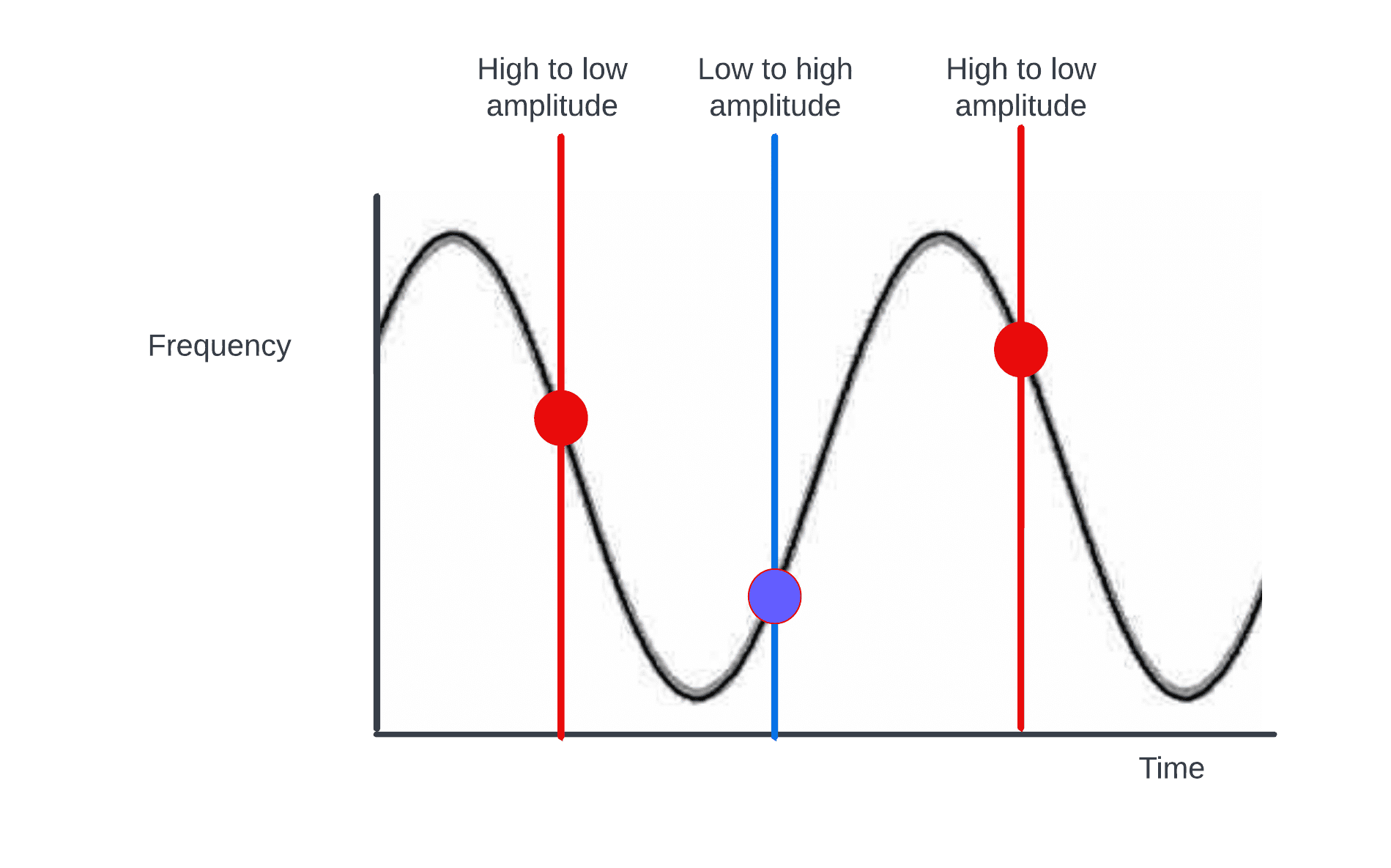
Okay, now we have stored the POIs for each song. But how do we compare the song and the sound clip?
First, it is important to point out that we cannot compare the POIs by the time component because it is not fixed. We are not sure what is the offset of the clip. Let's understand this with an example
We have a song with POIs at the 20s and 50s. The user starts recording the sound clip at the 10s mark, so for the sound clip, the POIs will be at 10s and the 40s. If we compare the frequency at the 20s match then it won't be a match.
To solve this issue
We will store pairs of POIs and the time duration between them. So the uniquely identifying characteristics for a song are (F_1, F_2, Time interval between F_1 and F_2)
Now if they find the same frequency with the same time delta in the clip that means there is a match. The song which has a maximum number of matches is our result.
But can we optimize this any further?
If there are n POIs there there will be n*(n-1)/2 pairs. So each comparison will have worst-case time complexity O(n^2).
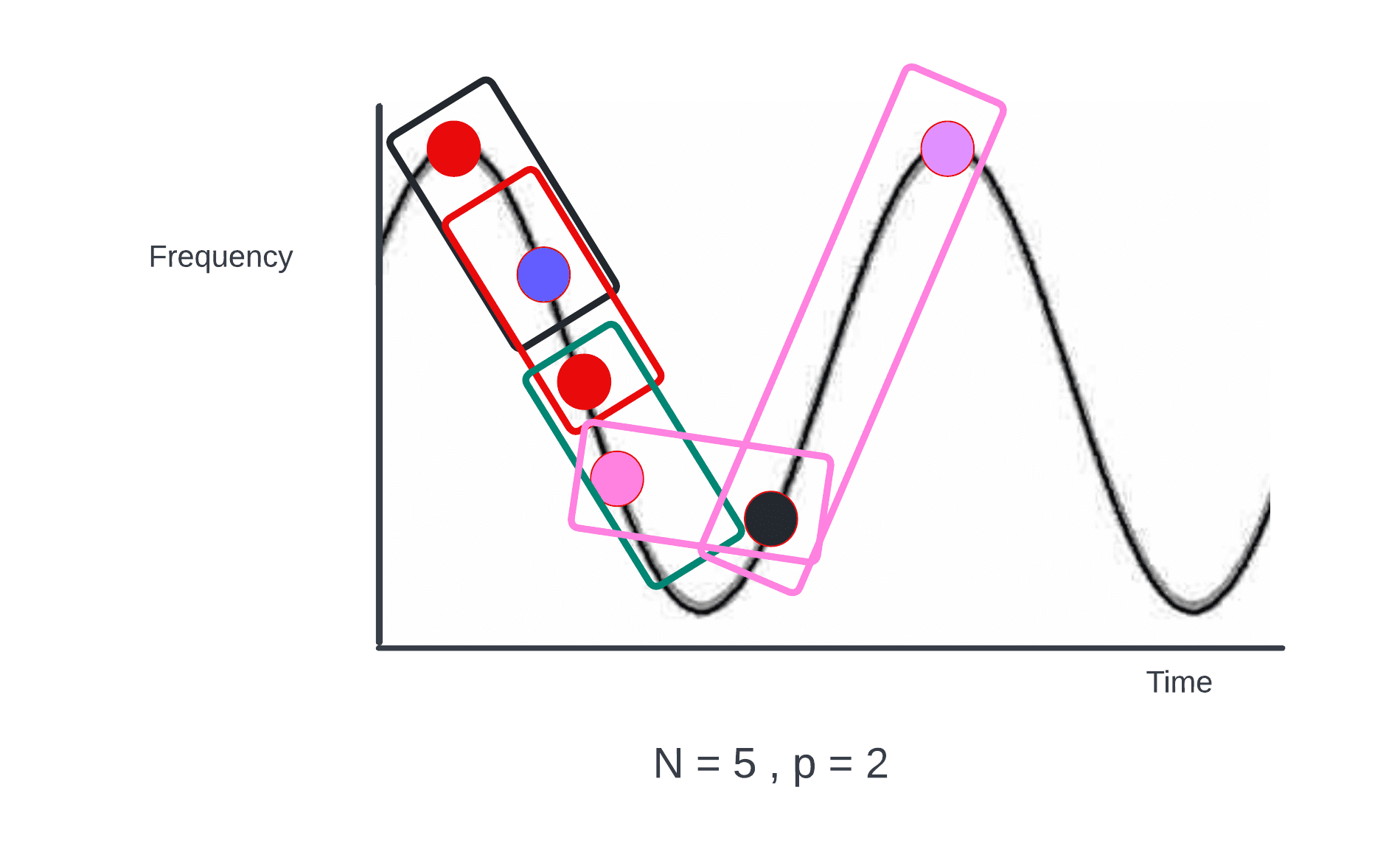
We can optimize this process by dividing the song into chunks and then comparing the chunks of the song and sound clip. If the chunks match then we have our song.
Problems arise when the two points are indifferent chunks.
We repeat the same process for the sound clip as well. Then we find the chunks having the maximum number of matches with our clip. The song which contains this chunk is our answer. (Notice that instead of comparing two pairs of POIs, we are comparing chunks).
Time complexity of this solution
Let's say we have n points and each chunk has p points. So there will be a total of (n-p) chunks.
So the time complexity will be: (n-p) * (p*(p-1))/2 = O(p^2 * (Number of blocks))
We can optimize this process even more. We can take the points in the chunks and convert them into a hash. Each hash is like a key. So when searching for a chunk we just search for the key. The song having the most number of matches with keys for its chunks is the song we are looking for. We can search for a key in O(1), so the search will be very fast.
Capacity Estimation
Storage estimation
Assumptions
- Total number of songs = 1,000,000
- Average length of each song = 3 min
- Average length of each clip = 10s
- Number of interesting points per chunk = 10
- Average number of requests per second = 1000
- Search time for a pair of points ~ 5ms
Size of each point (F1,F2,TimeInterval) = 4 bytes + 4bytes + 4bytes = 12bytes
Number of pairs per chunk = (10*(10 -1))/2 ~ 50 pairs
Average number of chunks per song = 3*60 / 10 ~ 20
Total storage = Number of songs * Number of chunks * Number of pairs * Size of each pair ~ 12 GB
Taking into account replication for fault tolerance and performance we multiply it with a factor of 3: 12*3 ~ 36 GB
Process estimation
Number of pairs in sound clip = (10*(10-1))/2 ~ 50 pairs.
Therefore, total processing time per second = Number of requests * Number of pairs in sound clip * search time = 1000 * 50 * 5ms ~ 250 seconds/second
We want to keep the load of the processors at about 60%, so the number of processors required = 250 / 0.6 ~ 400 processors
That's it for now!
You can check out more designs on our video course at InterviewReady.
