 Aryan Oberoi
Artificial intelligence has moved beyond generating standalone images and is now reshaping how images are edited, refined, and iterated upon. Modern AI image editing models no longer operate as simple pixel manipulators; they interpret semantic intent, spatial relationships, and visual context, enabling complex edits through natural language instructions rather than manual tooling.
This shift marks a critical inflection point for creative and production workflows. Image editing has become an interactive, intent-driven process where models must balance realism, precision, and user control across multiple iterations. This article presents a technical and comparative analysis of the most influential AI image editing models as of January 2026, examining how their architectural design choices translate into real-world editing capabilities and practical deployment scenarios.
1. Google Gemini 2.5 Flash Image (“Nano Banana”)
Category: General-Purpose, High-Fidelity Image Editing
Developed by Google, Gemini 2.5 Flash Image represents one of the most advanced general-purpose image editing models currently available. Often referred to by its internal nickname “Nano Banana,” the model is designed to jointly process visual inputs and textual instructions with a high degree of alignment between intent and output. Its architecture emphasizes visual realism, contextual awareness, and temporal consistency across multiple edits.
What distinguishes Gemini 2.5 Flash Image from earlier systems is its ability to preserve structural and photometric integrity during complex edits. When objects are removed or replaced, the model reconstructs background details such as lighting gradients, shadows, and textures in a way that minimizes visual artifacts. This consistency remains stable even across iterative edits, making the model suitable for professional workflows that require multiple revisions.
In practice, Gemini is most effective in scenarios where realism is critical. Applications such as product photography, marketing creatives, portrait editing, and social media visuals benefit from its strong understanding of real-world geometry and materials. Its low-latency inference also makes it viable for production environments where turnaround time is a constraint.
2. OpenAI GPT-Image-Latest (GPT-Image-1.5 / ChatGPT Image)
Category: Conversational and Iterative Image Editing
The GPT-Image series developed by OpenAI introduces a conversational paradigm to image editing. Rather than treating image modification as a single-shot operation, GPT-Image allows edits to be performed iteratively through dialogue. Each instruction builds upon the previous context, enabling the image to evolve gradually as the user's intent becomes clearer.
From a technical perspective, this conversational statefulness reduces the burden of prompt engineering. Users do not need to specify all constraints upfront; instead, they can refine the output through successive instructions. This approach aligns well with creative and exploratory workflows, where the desired result may not be fully defined at the outset.
GPT-Image demonstrates balanced performance across image generation and editing tasks, although its primary strength lies in semantic interpretation rather than pixel-level precision. It is particularly effective when edits involve stylistic changes, conceptual adjustments, or narrative-driven transformations. As a result, it is commonly used in creative prototyping, education, and experimental design contexts.
3. Seedream 4.0
Category: High-Resolution and Commercial Visual Editing
Seedream 4.0, developed by ByteDance, is optimized for high-resolution image editing and commercial-grade visual production. The model places strong emphasis on output clarity, fine detail preservation, and consistency across multiple assets. Unlike general-purpose editors, Seedream is designed with branding and marketing workflows in mind.
A defining feature of Seedream 4.0 is its ability to maintain visual identity across a set of images by using multiple reference inputs. This capability is particularly valuable in advertising and product design, where consistency across campaigns is essential. The model supports high-resolution outputs, including 4K images, making it suitable for both digital and print media.
Seedream’s strengths become most apparent in structured design environments where requirements are well defined. While it may be less conversational than GPT-Image, it compensates with high-fidelity outputs and strong control over composition and styling.
4. Qwen Image Edit (Qwen-Image-Edit / Qwen2.5-VL)
Category: Precision-Oriented and Semantic Editing
Qwen Image Edit, developed by Alibaba, is designed for precision-oriented image editing. The model excels at localized modifications, allowing users to alter specific regions of an image without affecting surrounding elements. This level of control is particularly important in enterprise and e-commerce settings.
Technically, Qwen demonstrates strong semantic understanding at the object and text level. It performs well in tasks such as replacing text within images, modifying signage, or adapting visuals for different languages and cultural contexts. Its multilingual prompt support makes it especially relevant for global content pipelines.
Rather than focusing on stylistic creativity, Qwen prioritizes correctness and semantic accuracy. This makes it well-suited for applications where precision outweighs artistic flexibility, such as localization, compliance-driven design, and catalog imagery.
Comparative Positioning Across Editing Workflows
While all four models operate within the domain of AI-driven image editing, they are optimized for different interaction paradigms and production constraints rather than competing directly on a single performance axis.
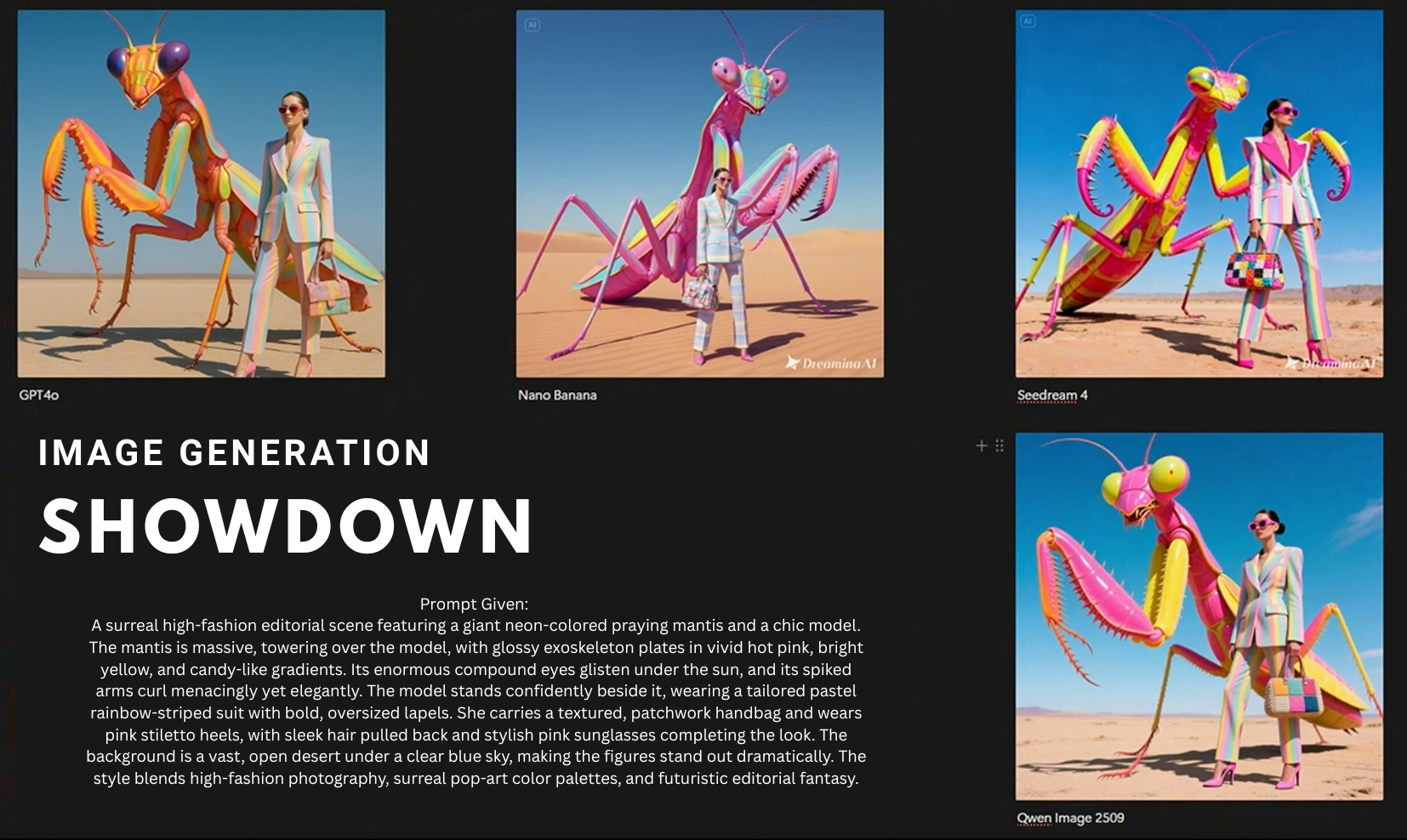
Models such as Gemini 2.5 Flash Image prioritize photorealism and visual coherence, making them well suited for workflows where realism and repeated revisions are critical. GPT-Image emphasizes conversational iteration, lowering the barrier for exploratory and creative editing where requirements evolve dynamically. In contrast, Seedream 4.0 focuses on high-resolution consistency and brand alignment, aligning closely with commercial and marketing pipelines. Qwen Image Edit occupies a precision-oriented niche, excelling in localized, semantically accurate modifications where correctness and control outweigh stylistic flexibility.
The practical distinction between these systems lies not in absolute quality, but in how they trade off control, creativity, fidelity, and interactivity. Selecting the appropriate model therefore depends on workflow intent rather than raw capability.
Final Remarks
The current generation of AI image editing models reflects a shift from generic image generation toward intent-driven, context-aware visual manipulation. Rather than competing directly, these models occupy distinct positions across the spectrum of realism, precision, interactivity, and deployment control.
Selecting the appropriate model depends less on absolute performance and more on alignment with the intended workflow, whether that involves commercial production, creative exploration, semantic precision, or infrastructure-level customization.
As these systems continue to evolve, the distinction between traditional image editing software and AI-driven workflows is likely to disappear entirely.
Frequently asked questions
What is the difference between AI image generation and AI image editing?
AI image generation focuses on creating images from scratch based on a prompt, whereas AI image editing operates on an existing image and modifies it while preserving visual structure, context, and consistency. Modern editing models understand semantic intent, spatial relationships, and visual continuity, enabling precise, controlled transformations rather than one-shot outputs.
Which AI image editing model is best for professional or commercial use?
The optimal model depends on the workflow. Models like Gemini 2.5 Flash Image and Seedream 4.0 are well suited for professional and commercial use due to their strong realism, consistency, and support for high-resolution outputs. They perform best in environments where visual fidelity and repeatability are critical.
When should conversational image editing models be preferred?
Conversational models such as OpenAI’s GPT-Image are ideal for exploratory and creative workflows where requirements evolve over time. Their ability to retain conversational context allows users to refine images iteratively without extensive upfront prompt specification.
Which model is most suitable for precise or localized image edits?
Qwen Image Edit is particularly effective for precision-oriented tasks such as localized object replacement, text modification within images, and multilingual visual adaptation. Its strong semantic accuracy makes it well suited for enterprise, localization, and compliance-driven workflows.
Are these models competitors or complementary tools?
Rather than direct competitors, these models occupy complementary positions across the image editing spectrum. Each prioritizes different tradeoffs between realism, interactivity, precision, and production control. In practice, organizations may use multiple models depending on the task and stage of the creative pipeline.
How should teams choose the right AI image editing model?
Model selection should be guided by workflow requirements rather than raw capability. Factors such as iteration style, output fidelity, consistency needs, semantic accuracy, and deployment constraints play a more important role than absolute performance metrics.