 AI Paper Summarizer
Understanding the Core Problem
Long-form narrative documents feature complex structures that often contain chapters and sections. Traditional retrieval tasks find these broad units insufficient due to internal semantic shifts that aren't visually marked. Relying on paragraph formatting alone risks misaligning narrative units, leading to poor retrieval quality.
Introducing the Breakthrough: LumberChunker
LumberChunker offers a solution by allowing a language model (LLM) to determine appropriate segmentation points, maintaining narrative coherence. This technique enhances Retrieval Augmented Generation (RAG) systems by ensuring that retrieved information is contextually complete and related.
Mechanism: The LumberChunker Methodology
1. Document Paragraph Extraction
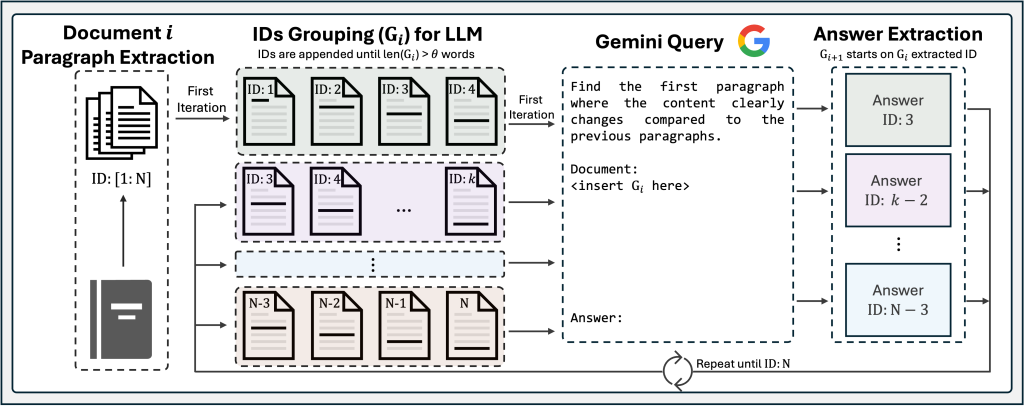
Documents are split into paragraphs with unique IDs to maintain discourse units and candidate boundaries.
2. Forming ID Groups
Paragraphs are grouped until a specified token budget is reached, allowing the LLM to discern significant shifts.
3. LLM Boundary Identification
The LLM identifies the earliest paragraph where a content shift occurs, marking it as a chunk boundary.
FAQs and Solutions
- Why is semantic coherence important in text segmentation? Semantic coherence ensures that narrative units are logically aligned, improving retrieval accuracy in RAG systems.
- How does LumberChunker compare to other chunking methods? LumberChunker provides consistently better retrieval by locating semantic boundaries, outperforming traditional methods.
- What is the optimal token setting for LumberChunker? Testing indicates that a token budget of approximately 550 offers optimal retrieval without losing context.