
Agentic systems have seen increased adoption in 2025. They are easy to build and run independently.
However, multi agent systems are much more complex. Most companies talk are interested in them, but very few are able to implement them in practice.
If you are an AI engineer, you will find this article useful. We have explained multi-agent systems in the following sections:
What are Multi-Agent Systems
When To Use Multiple Agents
What are the challenges in Multi-Agent Systems
How Multi-Agent Systems Work in Practice
What You Should Learn as an AI Engineer
This article is based on research from Cisco, Anthropic and Together AI. References are linked at the bottom of the article.
1. What are Multi-Agent Systems
An agentic system performs tasks independently. A multi-agent system has more than one agent, working together to meet a common goal.
For example:
A user enters a query in Amazon's search bar.
Amazon forwards the user query and their purchase history to a search agent.
The search agent finds the top 100 items most relevant to the query.
The agent then creates a bid amongst advertisers, who pay to rank their item on top.
The advertisers themselves are agents, who use current trends, pricing strategies and other factors to make the bid.
The final results, with ranked advertisements, are shown to the user.
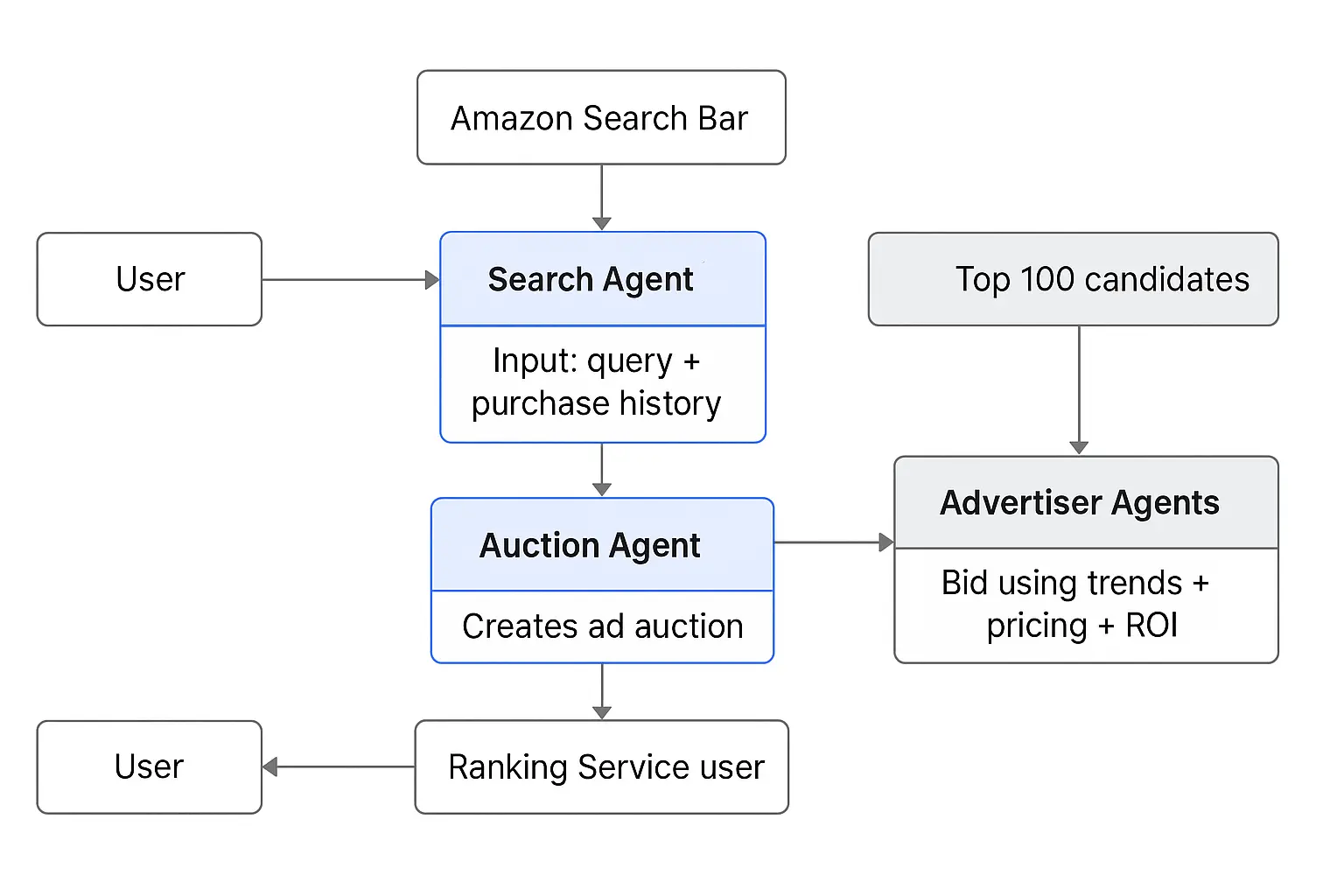
In this case, multiple agents interact with each other to serve a user's search request.
This requires orchestration, fault tolerance and an isolation of concerns, forming a Multi-Agent System.
2. When To Use Multiple Agents
Use Multi-Agent Systems for** workflows with heterogeneous expertise.**
user facing agents (communication / chat)
strong reasoning agents (thinking / planning)
In our above example, the advertisers are agents with thinking capabilities. Given a budget, they estimate the ROI of an advertisement before making a bid.
On the other hand, the user facing agent helps the user explain their requirements through chat, communicating as per company guidelines.
Both capabilities are essential for overall success, and therefore the agents are likely to use different models.
3. What are the challenges in Multi-Agent Systems
Most multi-agent systems fail because of semantic mismatch in communication.
A. Non-deterministic negotiation
Example:
“Book a ticket to New York”An agent cannot deterministically execute it.
This is a missing contract problem.
B. Missing protocol-level validationIf an agent sends:
{
    "destination": "New York"
}
There is no enforced schema that specifies:
which fields are required
which values are allowed
the order of communication
Everything is deferred to the LLM. Without a protocol, communication is unreliable.
4. How Multi-Agent Systems Work in Practice
Several mitigation strategies are used.
A. Centralized orchestration
One “boss” agent:
plans tasks
delegates to workers
merges results
This avoids peer-to-peer chaos but creates a **single authority, **which can be a bottleneck. This is also a single point of failure.
B. Prompt-level role fixing
Agents are given rigid roles:
“You are the planner”
“You are the executor”
“You are the critic”
This reduces drift, and isolates concerns.
C. Structured outputs and JSON schemas
Developers force agents to emit structured data:
JSON
Pydantic schemas
tool signatures
This helps downstream parsing, and provides a uniform communication language.
5. What You Should Learn as an AI Engineer
If you want to work on real agent systems, you should learn the following.
A. Distributed systems fundamentals
request failure handling
sync and async communication
orchestration / coordination strategies
Multi-Agent Systems are distributed systems, with similar problems and mitigation strategies.
B. Semantic modeling
defined domain schemas
clear task definitions
This matters more than clever prompting.
C. Protocol-level thinking
message envelopes
interaction patterns
If you learn those now, you will be ready when multi-agents finally deserve the hype.
Conclusion
Multi-Agent systems require coordination, contracts, and reliable communication. Without explicit protocols and well-defined responsibilities, these systems collapse.
If you want to build production-grade agentic and distributed AI systems, check out our AI Engineering course at InterviewReady.
References:
A Layered Protocol Architecture for the Internet of Agents: https://arxiv.org/html/2511.19699v2Mixture-of-Agents: https://arxiv.org/abs/2406.04692Mixture-of-Agents (Zilliz): https://zilliz.com/blog/mixture-of-agents-how-collective-intelligence-elevates-llm-performanceMulti-Agent collaboration patterns: https://aws.amazon.com/blogs/machine-learning/multi-agent-collaboration-patterns-with-strands-agents-and-amazon-nova/


