 Nitin Chaube
The 2026 AI Engineer - From Chatbots to THinking Machines
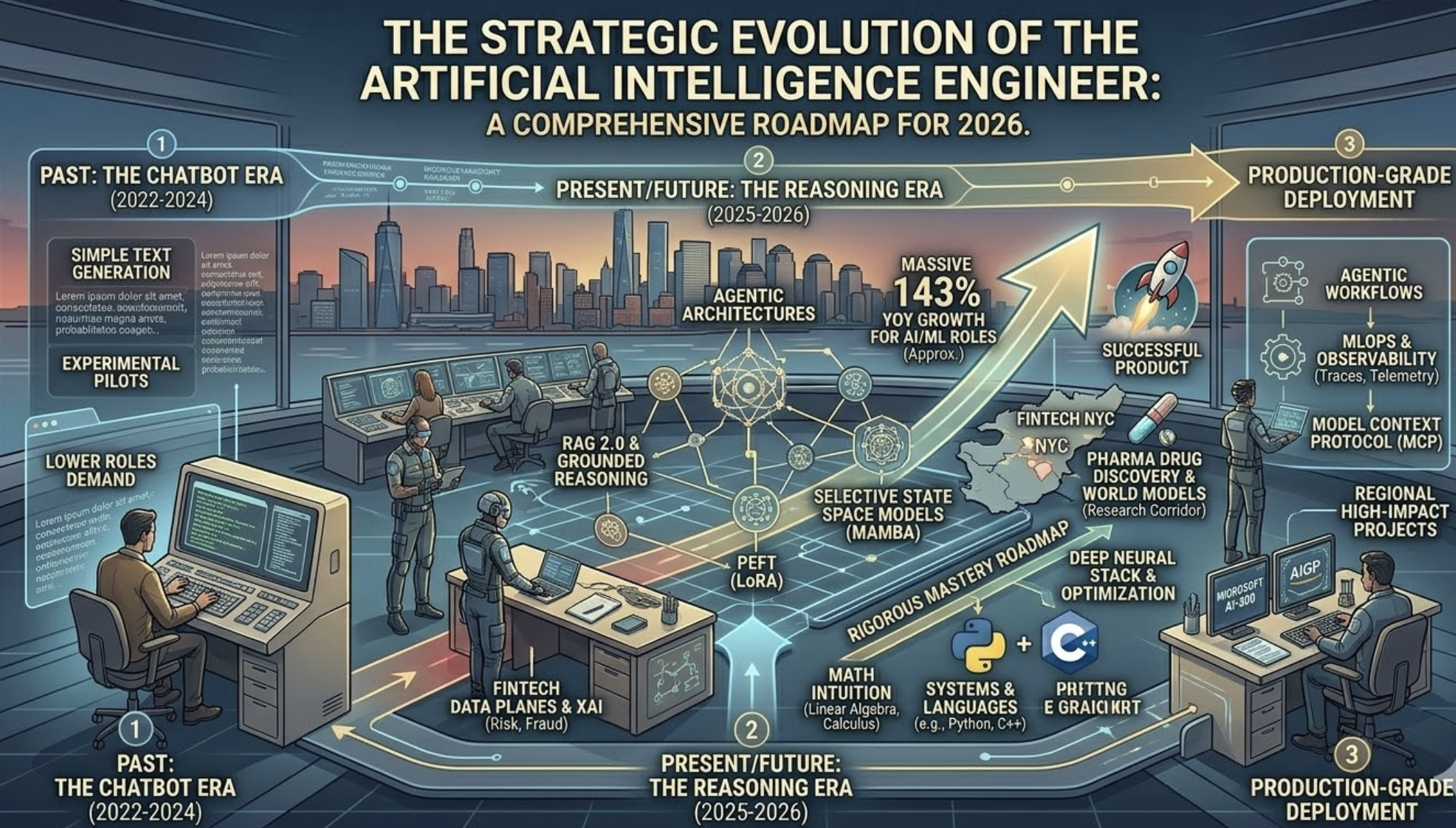
We’ve officially moved past the "Chatbot Era." In 2026, the world doesn't just need AI that can talk; it needs AI that can act. We are now in the Reasoning Era. This means the focus has shifted from simple text generators to "Agentic" systems, autonomous tools that can plan, solve multi-step problems, and run entire business workflows without a human holding their hand. Because of this, the role of the AI Engineer has exploded. It’s no longer just a sub-set of software engineering; it’s its own high-stakes discipline.
The demand is staggering. AI roles are growing at a rate of 143% every year. As companies move from "just testing" AI to putting it at the heart of their products, the bar for entry has been raised. To succeed as an AI Engineer today, you need more than just a few prompts, you need a solid grasp of "reasoning" architectures, high-speed languages, RAG 2.0 and the math that makes these digital brains tick.
This guide is your 2026 roadmap to mastering that stack and securing your place in the most important tech shift of our lifetime.
Who Does What?
Before you can become an AI Engineer, you need to know exactly what the role actually is? and just as importantly, what it isn't.
While Data Science, Machine Learning, and AI Engineering all share roots in algorithms and data, their daily goals in 2026 are entirely different. If you are transitioning from a traditional ML background, you'll find the focus shifting heavily from infrastructure to product.
Here is how the modern data ecosystem breaks down:
- The Data Scientist (The Detective): They are focused on the "why." They use heavy statistics and data analysis to uncover business insights and guide company strategy.
- The Machine Learning Engineer (The Builder): They are the architects of stability. Their job is to ensure the infrastructure can handle heavy computational loads, keeping models running reliably at scale without crashing.
- The AI Engineer (The Product Creator): This is where you sit. You occupy the sweet spot between research and real-world application. Your job is to take large language models (LLMs) and wire them into user-facing products. You are the one building out the RAG pipelines, creating multi-agent systems from scratch, and making sure the AI actually solves the user's problem.
A Day in the Life of an AI Engineer
Because AI Engineering is deeply tied to product development, success isn't just about tweaking a model until it's 1% more accurate. It’s about building features that work.
A typical Tuesday in 2026 might involve debugging a recursive logic loop in a multi-agent workflow, setting up a specialized RAG application (like an AI academic advisor), or writing structured code in frameworks like DSPy to optimize your prompt architecture.
Because this specific blend of software engineering and cognitive orchestration is so rare, AI Engineers currently command some of the highest salaries in the tech world. Entry-to-mid-level roles frequently exceed $165,000, with senior architects pulling in significantly more.
| Feature | Data Scientist | Machine Learning Engineer | AI Engineer |
|---|---|---|---|
| Primary Goal | Extract insights to guide business decisions. | Build stable, scalable infrastructure for models. | Design and ship end-to-end intelligent agents. |
| Daily Focus | Statistical analysis and business strategy. | MLOps, CI/CD pipelines, and latency tuning. | LLM orchestration, RAG, and agent logic. |
| Success Metrics | Quality of decisions and KPI growth. | Uptime, system speed, and preventing data drift. | Cost per inference, user engagement, and task success. |
| Average Pay (US) | ~$172,000 (Median Total) | ~$158,420 (Average Base) | $150,000 - $250,000+ |
PHASES OF AN AI ENGINEER
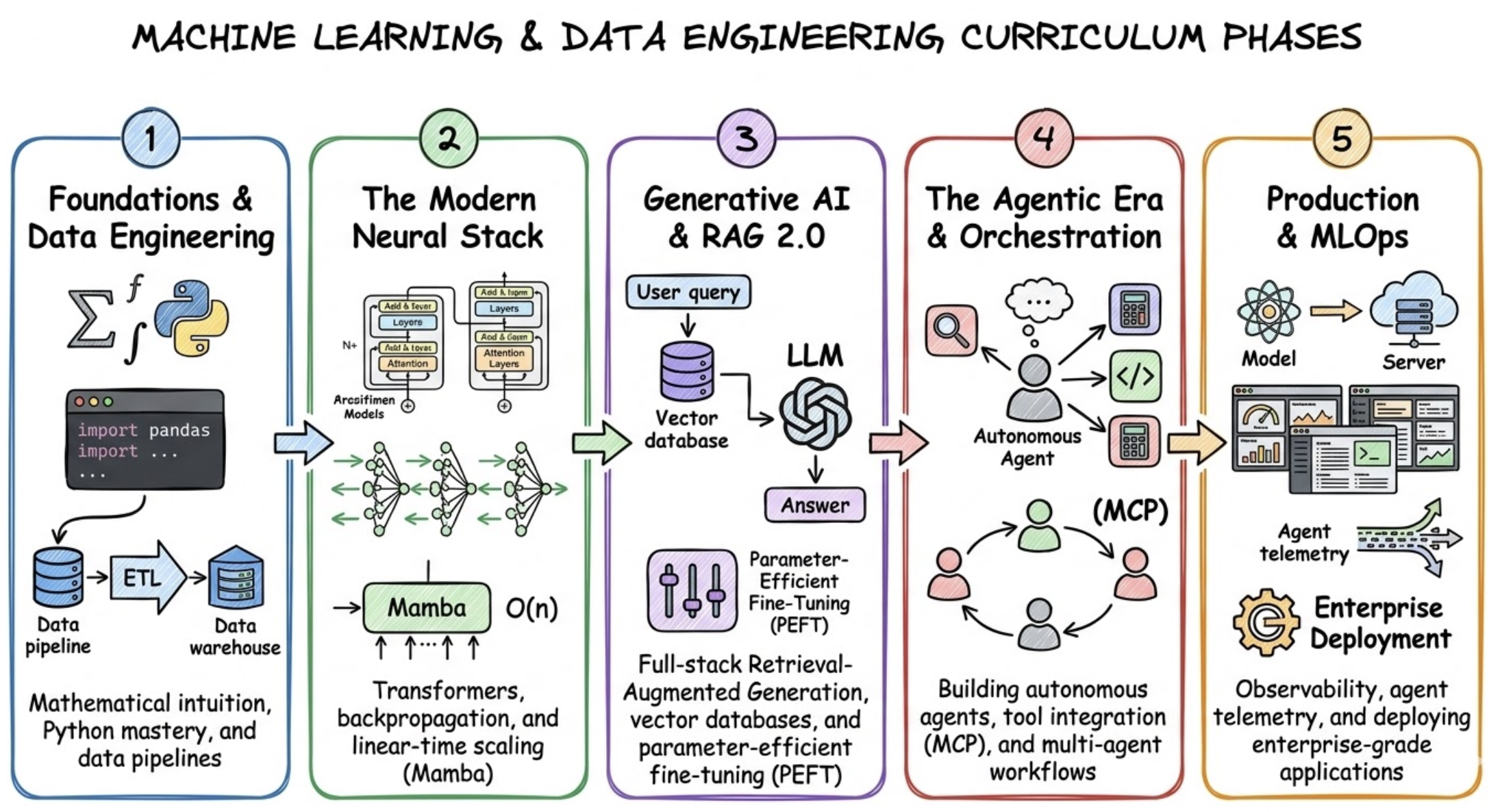
Transitioning from standard software development or traditional machine learning to building robust, multi-agent systems from scratch doesn't happen overnight. It requires a rigorous journey of focused, iterative building. Here is the phase-by-phase breakdown of exactly what you need to master:
Phase 1: Foundations & Data Engineering
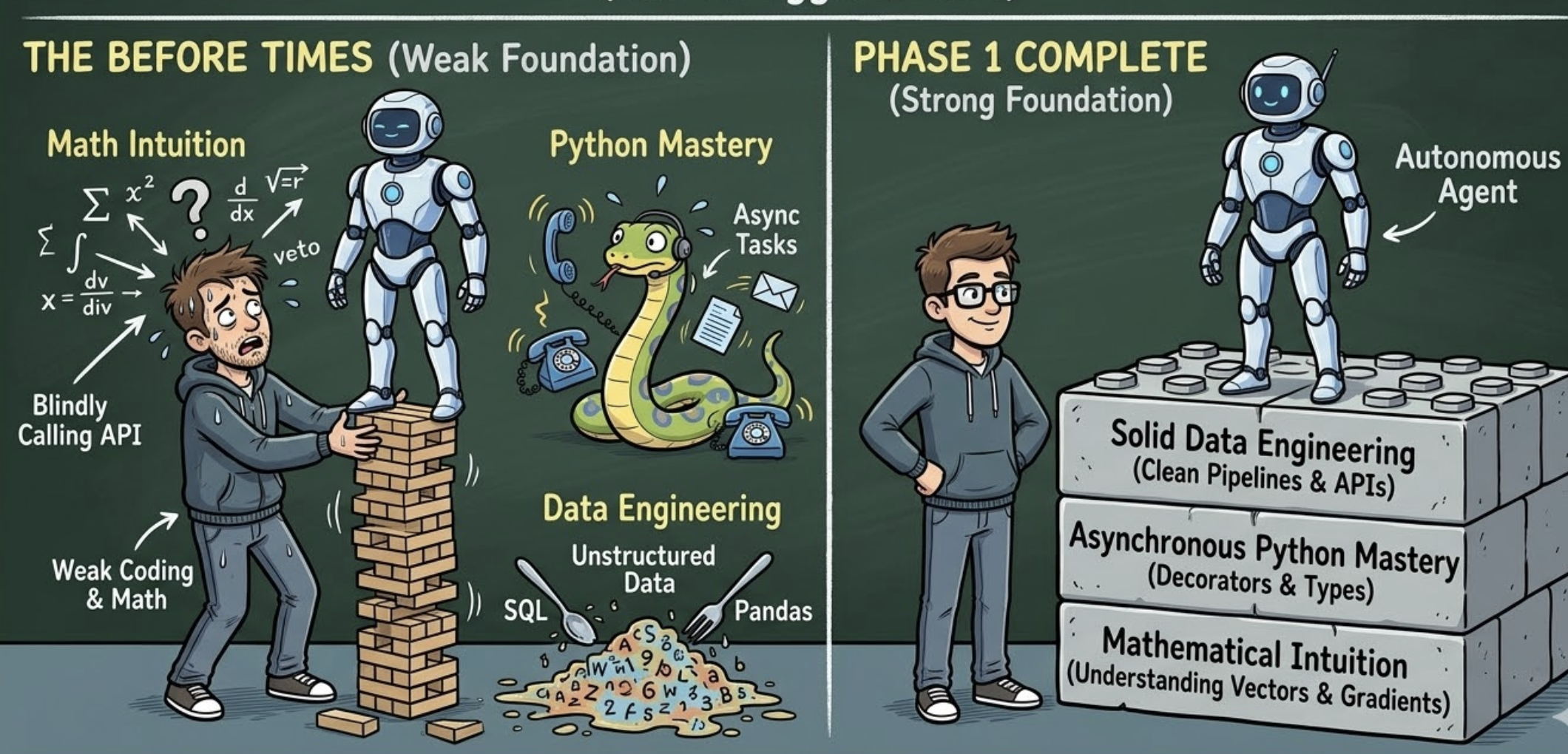
You cannot build a scalable AI product on a weak foundation. The first phase of your journey is about resetting how you view programming and mathematics.
1. The Mathematical "Intuition" Layer
In 2026, you don't need to memorize equations on a whiteboard, but you must build a deep intuition for how math influences model behavior in high-stakes environments. This is the difference between blindly calling an API and actually troubleshooting why an autonomous agent failed to converge on a solution.
- Linear Algebra (The Language of AI): Everything from text, audio, images is converted into a vector. You need to understand Latent Representations and how dot products measure the similarity between tokens in a vector space.
- Calculus & Gradients (The Engine of Improvement): Calculus powers optimization. Understanding derivatives is essential for managing the training process. Your main challenge will be understanding how to adjust the learning rate during fine-tuning to ensure your model actually learns without overshooting its goals.
- Statistics & Probability (Managing Uncertainty): We've moved from deterministic programming to probabilistic design. You must be proficient in Bayesian inference and confidence intervals to evaluate if your new agent logic is statistically superior to the old one.
2. Python as the Universal Superglue
If you want to build AI products, Python is your absolute foundation. Its clean syntax and massive ecosystem make it the undisputed default for orchestrating agentic workflows. However, modern Python proficiency for an AI Engineer goes beyond basic scripting. If you are going to build multi-agent systems from the ground up, you must master:
- Asynchronous Programming: So your agents can make multiple external API calls and retrieve data simultaneously without freezing your application.
- Decorators and Type Hinting: To build clean, maintainable, and scalable enterprise codebases that product teams can actually read and rely on.
3. Data Engineering Basics
Before you can orchestrate a complex RAG application, you need to know how to handle the data that feeds it. This step requires getting your hands dirty with SQL and Pandas for data manipulation, understanding vectorization techniques, and finally, building a simple REST API to serve a classic machine learning model. This proves you can bridge the gap between a standalone script and an accessible application.
Phase 2: The Modern Neural Stack
Once you have a grip on the data and the math, it is time to build the actual brains of your operation. In 2026, the distinction between "classic" machine learning and "deep" learning is more than just a matter of complexity; it is about choosing the exact right architecture for the specific constraints of your task.
1. Classical Algorithms and the "Small Data" Problem
Despite the overwhelming dominance of neural networks and large language models, classic machine learning algorithms are absolutely not dead. If you are dealing with structured tabular data, limited sample sizes, or strict low-latency requirements, models like Random Forests, XGBoost, and Support Vector Machines (SVMs) remain essential. As an AI Engineer, you must be highly adept at Feature Engineering, the art of selecting and mathematically transforming raw data into meaningful inputs. Even in the age of generative AI, garbage data in means garbage reasoning out.
2. Deep Learning and the Transformer Backbone
The modern neural stack is still heavily built upon the Transformer architecture. Before you can build agents, you must deeply understand its core mechanics:
- Tokenization & Embeddings: How words, image patches, or audio snippets are chopped up and mapped into high-dimensional vector spaces.
- Self-Attention: The mechanism that allows the model to weigh the importance of every word in a sentence relative to every other word, creating deep contextual understanding.
- Backpropagation: The process where the error of the model is distributed backward through its layers to adjust weights and biases during training.
However, the traditional Transformer has a fatal flaw that you must learn to engineer around: The Quadratic Bottleneck. In a standard Transformer, the computational cost grows by the square of the sequence length O(N^2). If you try to process a massive, million-token context window (like an entire codebase or a year of industrial sensor logs), the memory and compute requirements become prohibitively expensive.
3. The 2026 Shift: Selective State Space Models (SSMs)
Because of the quadratic bottleneck, 2026 is defined by the rise of post-Transformer architectures. The most critical one to master is the Selective State Space Model (SSM), famously exemplified by the Mamba architecture. Mamba offers linear-time scaling O(N). It achieves this by replacing explicit self-attention with a compact, evolving hidden state that dynamically decides what information to retain or "forget" based on the current token's content. This makes SSMs the absolute default choice for processing incredibly long documents or real-time streaming audio where context history is vast.
4. Building Hybrid Backbones
You won't always choose one or the other. Today’s top AI Engineers are increasingly tasked with building Hybrid architectures (like Jamba). These systems mix Transformer layers (for complex global reasoning and chain-of-thought) with Mamba layers (for highly efficient, long-horizon memory), orchestrating them into a single, lightning-fast enterprise LLM.
Phase 3: Generative AI & RAG 2.0
Generative AI has evolved from a niche experimentation field into the absolute primary driver of enterprise software development in 2026. As an AI Engineer, your job here isn't just to generate text it's to guarantee accuracy, compliance, and real-time intelligence. The "Generative AI Engineering Stack" now requires mastery over a highly specific set of tools for retrieval, customization, and multi-modal generation.
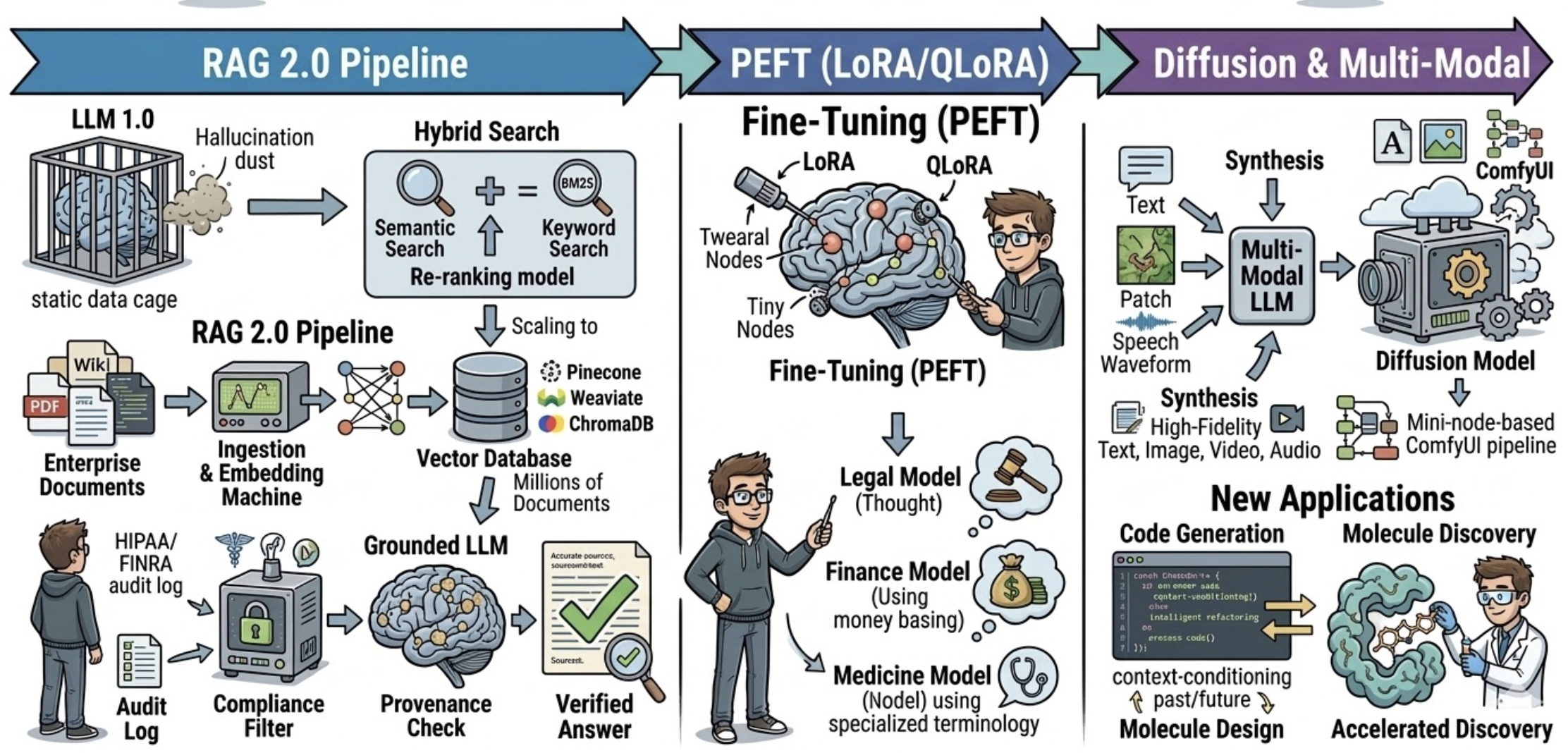
1. RAG 2.0 (Grounded Reasoning)
Traditional Large Language Models (LLMs) have two major flaws: they are limited by the static data they were trained on, and they tend to hallucinate facts. Retrieval-Augmented Generation (RAG) has shifted from a novel technique to a production-critical architecture that solves both issues by grounding model responses in dynamic, domain-specific external knowledge bases. To build a modern RAG 2.0 pipeline, you must master:
- Ingestion and Embedding: Transforming raw enterprise documents (PDFs, codebases, wikis) into searchable vectors using high-performance embedding models.
- Vector Databases: Utilizing specialized data stores like Pinecone, Weaviate, or ChromaDB to scale your retrieval across millions of documents instantly.
- Hybrid Retrieval: Combining modern semantic search with classic keyword search (BM25) and advanced re-ranking models to ensure the absolute most relevant context hits the top of the pile.
- Contextual Filtering: Applying strict safety filters and provenance checks to ensure the retrieved information is audit-ready and compliant with industry regulations (like HIPAA or FINRA).
2. Parameter-Efficient Fine-Tuning (PEFT)
While RAG provides the facts, fine-tuning is often necessary to adapt a model's style, persona, or instruction-following capabilities. In 2026, the industry has standardized on PEFT techniques like LoRA (Low-Rank Adaptation) and QLoRA. These techniques allow you to heavily customize a massive foundational model with minimal computational resources by only training a tiny fraction of the model's weights. This is particularly critical for domain-specific applications in legal, finance, or medicine, where the model must strictly adhere to specialized terminologies and output formats.
3. Diffusion Models and Multi-Modal Expansion
The generative landscape of 2026 extends far beyond text. As an AI Engineer, you must build multi-modal systems combining speech, image, and text. Diffusion models have completely surpassed older architectures (like GANs) in synthesizing high-fidelity images, video, and audio. Your toolkit here involves working with the Diffusers library, advanced Stable Diffusion versions (like SDXL-Lightning or Flux), and node-based visual tools like ComfyUI to build complex generation pipelines.
A transformative trend to watch in 2026 is the application of diffusion models to non-visual tasks:
- Code Generation: Diffusion models that generate code out-of-order, allowing for more human-like editing and intelligent refactoring by conditioning on both past and future context.
- Molecule Discovery: Utilizing equivariant diffusion models to design de novo ligands for pharmaceutical research, conditioned on specific protein pockets to radically accelerate drug discovery.
Phase 4: The Agentic Era & Orchestration
By 2026, the primary focus of AI engineering has shifted away from simple chat interfaces. The industry standard is now the Autonomous Agent, a software system capable of performing multi-step tasks with little to no human intervention. In this phase, you are no longer just prompting a model; you are building a cognitive architecture. Your systems must plan, reason, adapt, and orchestrate multiple tools by integrating deeply with external business infrastructure.
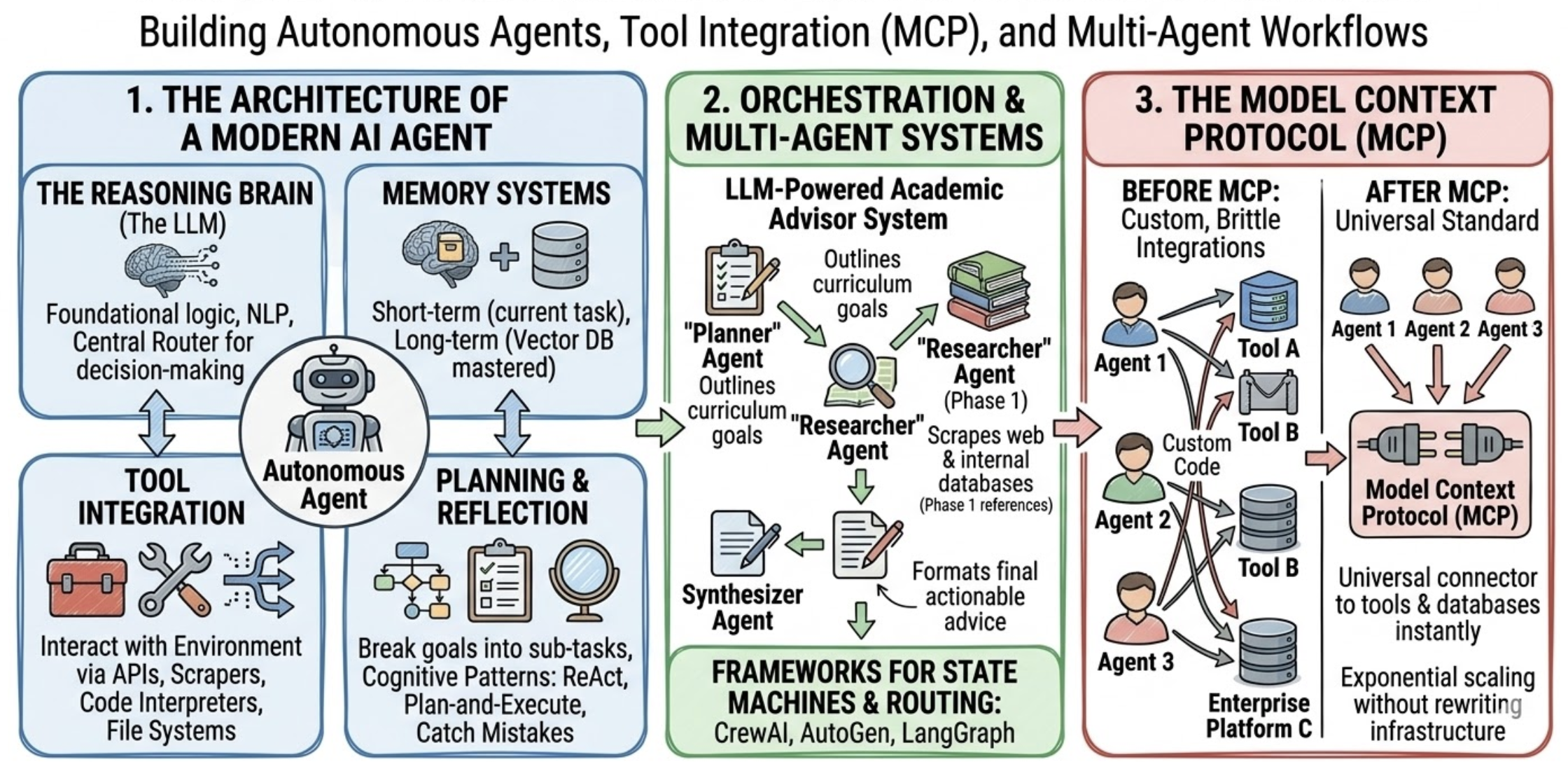
1. The Architecture of a Modern AI Agent
To build an agent, you must construct four primary pillars:
- The Reasoning Brain (The LLM): This provides the foundational logic and natural language processing capabilities. It acts as the central router for decision-making.
- Memory Systems: Agents need context. This includes short-term memory (for the immediate back-and-forth of a current task) and long-term memory (often stored in the vector databases you mastered in Phase 3) to learn and recall information over time.
- Tool Integration: An agent is useless if it can't affect the real world. This is the ability to interact with the environment through APIs, web scrapers, code interpreters, and file systems.
- Planning and Reflection: The agent’s ability to break a massive goal into sub-tasks and review its own actions. You will need to implement cognitive patterns like ReAct (Reason + Act) or Plan-and-Execute loops so the agent can catch its own mistakes before finalizing a task.
2. Orchestration and Multi-Agent Systems
The most complex and highly-valued applications in 2026 involve Multi-Agent Systems. This is where different specialized agents collaborate to solve a larger, overarching problem. Instead of one massive prompt, you build a "crew." For example, if you were building an autonomous research agent or an LLM-powered academic advisor system, your architecture might involve a "Planner" agent that outlines the curriculum or research goals, a "Researcher" agent that scrapes the web and internal databases, and a "Synthesizer" agent that formats the final actionable advice.
To manage these complex workflows, state machines, and routing logic, you must master industry-standard frameworks like CrewAI, AutoGen, and LangGraph.
3. The Model Context Protocol (MCP)
To standardize how these agents interact with their environment, the industry has universally adopted the Model Context Protocol (MCP). Before MCP, engineers had to write brittle, custom integration code for every single database or API an agent needed to touch. MCP is a universal standard that allows AI models to connect to external tools, databases, and enterprise platforms instantly. By mastering MCP, you ensure your agentic systems are "tool-aware" from day zero, allowing you to scale their capabilities exponentially without rewriting your core infrastructure.
Phase 5: Production, MLOps & The 2026 Infrastructure
Building a multi-agent system on your laptop is one thing; deploying it to serve thousands of concurrent users is another. As models grow in size and complexity, the "cost of intelligence" has become a primary driver of engineering decisions. In this final phase, you move from development to operations, mastering the infrastructure that keeps the Reasoning Era running.
1. Programmatic Prompt Optimization (DSPy)
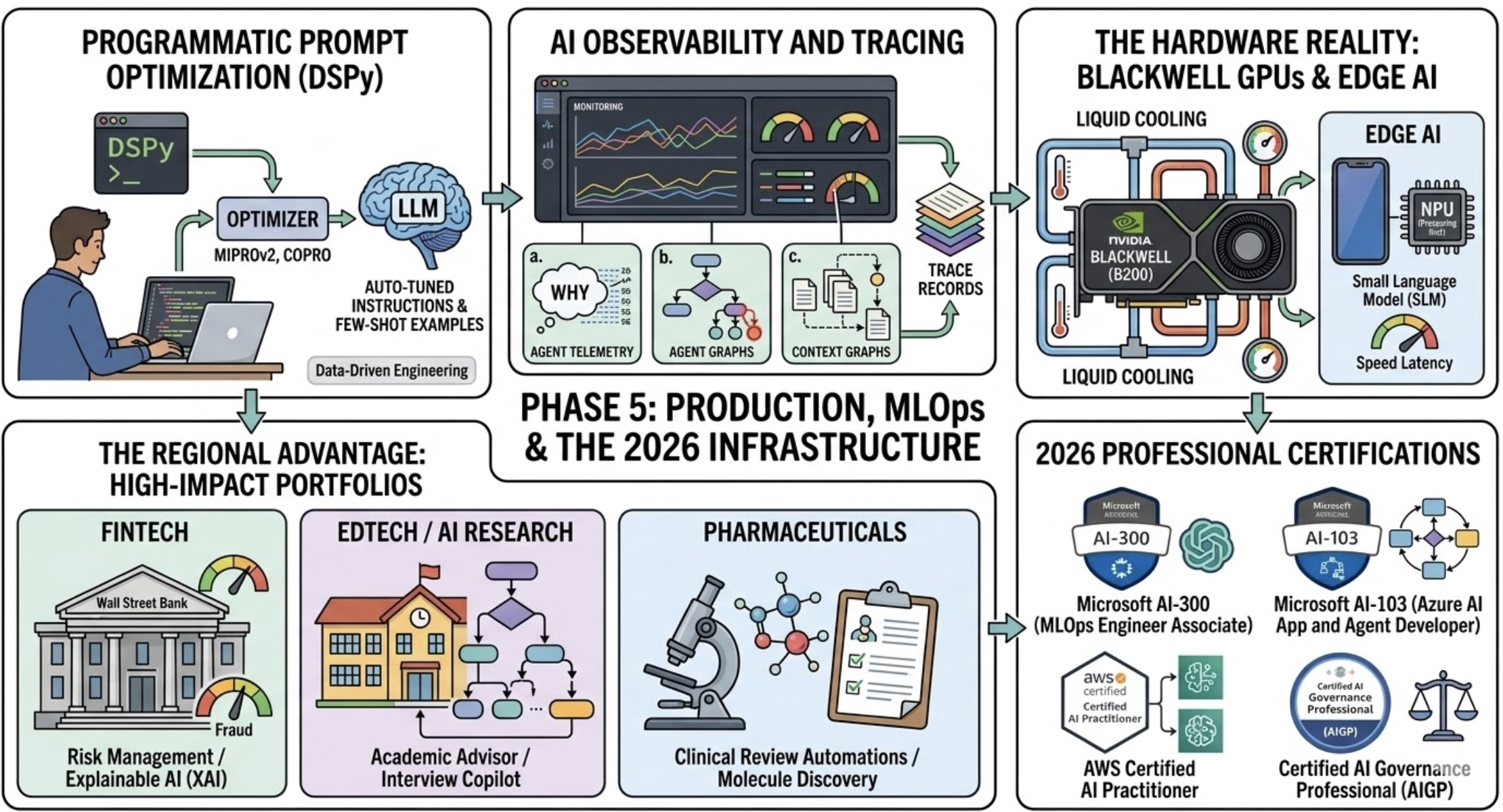
Manual prompt engineering, tweaking strings of text and doing "vibe checks" is dead. By 2026, AI Engineers optimize instructions programmatically. Using frameworks like DSPy (Declarative Self-improving Python), you define your LLM pipelines using structured code. DSPy uses advanced optimizers (like MIPROv2 or COPRO) to automatically tune instructions and select the best few-shot examples based on specific success metrics. It turns prompt design from a dark art into rigorous, data-driven software engineering.
2. AI Observability and Tracing
Traditional software monitoring (tracking CPU usage and RAM) is completely insufficient for agentic systems. An autonomous agent can fail by making a syntactically valid but semantically disastrous decision. To deploy safely, you must build a modern AI observability stack around traces, durable records of an agent's reasoning process.
- Agent Telemetry: Capturing exactly why a decision was made before a single token is generated to the user.
- Agent Graphs: Visualizing the execution tree to identify exactly where a multi-step reasoning loop broke down (critical when an autonomous research agent gets stuck in a recursive loop).
- Context Graphs: Maintaining persistent records of retrieved context to prove provenance.
3. The Hardware Reality: Blackwell GPUs & Edge AI
You must understand the metal your models run on. 2026 infrastructure is defined by NVIDIA's Blackwell architecture (like the B200 systems). Featuring 192GB of HBM3e memory and massive compute density, these systems have forced an industry-wide data center redesign toward liquid cooling to handle the massive heat loads. Simultaneously, we are seeing a massive shift toward Edge AI. To reduce latency and ensure privacy, engineers are deploying Small Language Models (SLMs) directly on local devices using lightweight Neural Processing Units (NPUs) and FPGAs.
4. The Regional Advantage: High-Impact Portfolios
To land top-tier roles, your portfolio projects must reflect real enterprise needs, especially if you are targeting the highly mature markets.
- Fintech & Enterprise Systems: Engineers here focus on Agentic Data Planes for risk management, fraud detection, and autonomous workflows. If you have a background in enterprise software (like building systems for massive pension funds, insurance providers, or financial institutions), your focus should be on Explainable AI (XAI) to meet strict Wall Street regulations.
- EdTech & AI Research: Building robust systems for technical assessments or learning-oriented research agents is a massive growth vector. Demonstrating a project like an LLM-powered academic advisor or an AI interview copilot proves you can handle complex reasoning graphs.
- Pharmaceuticals: For the Research, engineers are utilizing world foundation models to simulate intricate physical interactions and automate clinical literature reviews.
5. 2026 Professional Certifications
Finally, validate your skills. Certifications have evolved to reflect integrated AI ecosystems rather than simple tool knowledge:
- Microsoft AI-300 (MLOps Engineer Associate): The gold standard for operating generative AI systems in production.
- Microsoft AI-103 (Azure AI App and Agent Developer): Specifically targets the development of autonomous agents and multi-step workflows.
- AWS Certified AI Practitioner: Validates knowledge of the AWS Bedrock and SageMaker ecosystems.
- Certified AI Governance Professional (AIGP): Essential for those moving into leadership or high-regulation sectors like finance.
Conclusion: The Era of the AI Engineer
The AI Engineer of 2026 is far more than a software developer; you are the architect of a new era of cognitive automation. The roadmap is demanding, requiring mathematical intuition, Python mastery, and a deep understanding of autonomous reasoning. But the bottleneck in technology is no longer raw compute; it is the engineering talent capable of building reliable, safe, and performant agentic systems. The transition from experimentation to execution is complete. It is time to build.
Thanks to you all for reading till here. I hope you achieve what you want in your life.
Frequently asked questions
How has prompt engineering changed for production systems?
Manual prompt engineering, relying on tweaking text and doing "vibe checks" is obsolete. In 2026, engineers use frameworks like DSPy for programmatic prompt optimization. This turns prompt design into rigorous software engineering, using advanced optimizers to automatically tune instructions and select the best examples based on hard performance metrics.
Why is mathematical intuition still important in 2026 if APIs handle the heavy lifting?
While you don't need to memorize complex equations on a whiteboard, a deep understanding of linear algebra, calculus, and probability is crucial for troubleshooting why an agent failed to reason correctly. It allows you to effectively tune learning rates and manage the uncertainty inherent in probabilistic AI systems.
What is the difference between standard Transformers and models like Mamba?
Traditional Transformers suffer from a "quadratic bottleneck," meaning computational costs skyrocket as the context window grows. Mamba, a Selective State Space Model (SSM), solves this by offering linear-time scaling. This makes Mamba far more efficient for processing massive documents or real-time streaming data without maxing out memory.
How does RAG 2.0 fix the flaws of traditional Large Language Models (LLMs)?
Standard LLMs rely on static training data and are prone to hallucinating facts. RAG 2.0 solves this by connecting the model to dynamic, external knowledge bases (like enterprise wikis or vector databases). This grounds the model's reasoning in verified data, ensuring highly accurate, audit-ready, and compliant responses.
What is the Model Context Protocol (MCP) and why is it essential for autonomous agents?
Before MCP, developers had to write custom, brittle integration code for every single database or API an AI agent needed to use. MCP acts as a universal standard, allowing agents to instantly and seamlessly connect to external tools and enterprise environments, making them infinitely more scalable.