
NeurIPS 2025’s highest-ranked paper is titled Artificial Hivemind: The Open-Ended Homogeneity of Language Models (and Beyond).
Core Idea: As LLMs scale, they tend to have similar outputs.
The "Artificial Hivemind" paper introduces a new dataset specifically for open-ended user queries. The dataset has prompts like "Write me an essay" or "Think of a startup" idea.These questions have more than one correct answer. The researchers collected 26,000 open-ended prompts.The answers to these questions were annotated and ranked by humans.
The model was trained on this dataset, with surprising results.
1. Intra-model collapse
When multiple outputs are sampled from the same model on an open-ended prompt, they cluster tightly.Even with randomness, the model keeps circling the same ideas with the same tone and structure.
2. Inter-model collapse
When different frontier models were queried with the same prompt, they:
used similar abstractions
produced similar answers
converged stylistically
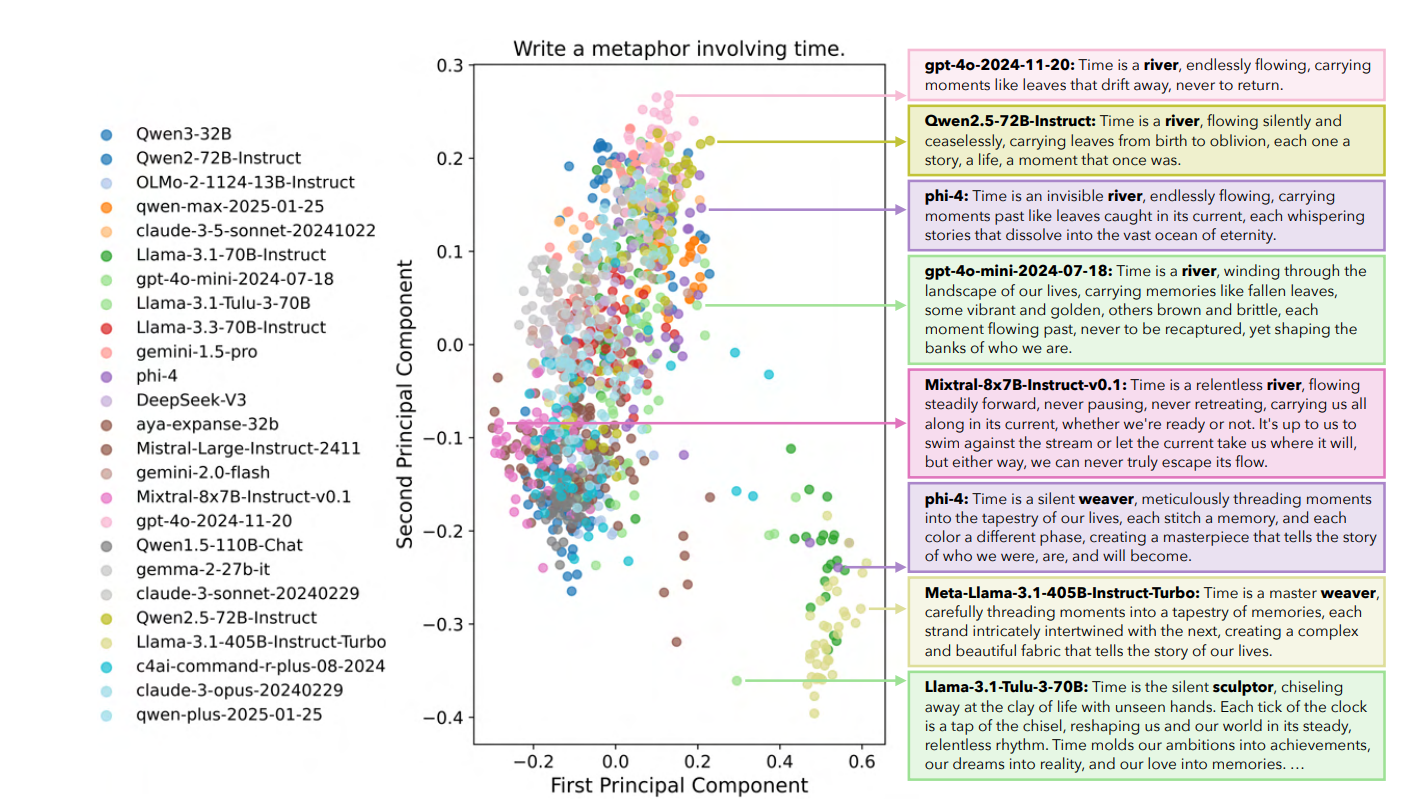
The graph shows extremely tight clustering of model outputs, despite no single correct answer to the questions. This is called the Artificial Hivemind Effect.
3. Loss of Diversity
The dataset contained 25 human annotators per prompt. The paper separated prompts into 2 groups:
prompts where humans collectively agree (legal, factual, etc...)
prompts where humans collectively disagree (goals, politics, etc...)
The researchers discovered that models optimize for the median preference, flattening valuable human disagreement into a single homogenized target. This is a known failure mode of RLHF.
Root Cause: LLMs have similar training
Across labs, training data has:
similar sources
similar writing styles
similar processing
This overlap could explain similar LLM outputs across organisations.
Another problem is that RLHF optimizes for **a single scalar reward. **That scalar reward forces the model to maximize average reward. This destroys the underlying diversity in human preference scores.
TLDR: The models became biased toward consensus-safe, culturally neutral, non-polarizing responses.
Why it matters: Diversity loss is a business problem
Most LLM wrappers claim "model-choice" as a feature. The research shows this won’t hold.
Switching scaled models won’t give different ideas (RLHF causes output collapse)
AI-generated writing already shows reduced variation (Synthetic data makes homogenization worse)
AI could reduce the quality of social media interactions (Increasing biases are an AI safety concerns)
The problem isn’t that AI will disagree with us, but that AIs will agree with each other.
If you’re a software engineer, this is the moment to level up.
The AI landscape is converging. The real differentiator left is your ability to understand how these systems work under the hood.
That’s what we teach in the AI Engineering Course at InterviewReady:
How LLMs work under the hood
How RLHF, Chain of Thought powers Reasoning Models
How to build RAG systems, Agents, and production-grade pipelines
How to think like an AI engineer
If you want to learn the engineering behind AI systems, try this AI course with over 30+ AI engineering topics.
Cheers!
References:
Artificial Hivemind: The Open-Ended Homogeneity of Language Models (and Beyond): https://arxiv.org/pdf/2510.22954Platonic Representation Hypothesis: https://arxiv.org/pdf/2405.07987


